Infinite-Uptime

Author: Iu_Zer0

  • What Is Prescriptive Maintenance and Why It’s the Future of Industrial Reliability?

    What Is Prescriptive Maintenance and Why It’s the Future of Industrial Reliability?

    Why Prescriptive Maintenance is the Future of Industrial Reliability?

    Read Time: 5–6 minutes | Author – Kalyan Meduri

    A team of three professionals in a modern industrial office collaboratively reviewing data on a multi-monitor workstation. A man points toward one of four large screens displaying colorful data dashboards, while a woman and another seated man look on intently. The background features a large, glass-walled manufacturing facility with machinery.

    As industries continue to evolve with digital transformation, traditional maintenance practices are being replaced by intelligent, AI-driven systems. One of the most advanced among these is Prescriptive Maintenance — a technology that not only predicts when equipment might fail but also recommends what actions to take to prevent it.Let’s break down what prescriptive maintenance is, how it works, and why it’s reshaping industrial reliability.

    What is Prescriptive Maintenance ?

    Prescriptive Maintenance is an advanced maintenance approach that uses data, analytics, and artificial intelligence to determine not only when equipment is likely to fail, but also to recommend specific actions to prevent failures. It guides organizations on what maintenance tasks to perform, when to perform them, and how to prioritize actions, enabling improved equipment reliability, reduced downtime, and more effective use of maintenance resources.

    Prescriptive Maintenance Example

    A sensor on a steel plant’s rolling mill gearbox picks up rising vibration while the mill is under heavy load. The system links the vibration to the process conditions and identifies the likely cause, a misaligned coupling. Its prescription is to realign the coupling and tighten the base bolts at the next planned stop, which avoids an unplanned shutdown. The operator then confirms the fix worked, and the system learns from that result for future prescriptions.

    Benefits of Prescriptive Maintenance

    Adopting Prescriptive Maintenance delivers measurable improvements across equipment performance, operational reliability, and cost efficiency. By combining AI-driven insights with real-time data analytics, it helps organizations transition from reactive responses to proactive, outcome-focused strategies.Key Benefits Include:

    1. Reduced Unplanned Downtime

    Prescriptive Maintenance identifies the earliest signs of equipment degradation or failure through continuous data monitoring. By prescribing precise corrective actions before a breakdown occurs, it prevents costly production interruptions and ensures consistent uptime across critical assets.

    2. Lower Maintenance Costs

    Instead of following fixed maintenance schedules, Prescriptive Maintenance recommends maintenance only when and where it’s needed. This targeted approach eliminates unnecessary part replacements, reduces labor costs, and minimizes inventory waste — optimizing every maintenance investment.

    3. Improved Asset Lifespan

    By maintaining equipment in optimal working condition, prescriptive systems extend the life of assets significantly. Continuous health tracking and timely interventions prevent minor faults from escalating into major failures, protecting your capital equipment and maximizing return on investment.

    4. Increased Throughput

    When machines operate smoothly without unexpected stoppages, production efficiency rises naturally. Prescriptive insights allow maintenance and operations teams to focus on performance optimization rather than crisis management, improving output, quality, and throughput across the plant.

    5. Enhanced Safety

    Unplanned failures can often lead to unsafe conditions for both equipment and personnel. Prescriptive Maintenance minimizes this risk by identifying potential hazards early — such as overheating, vibration imbalance, or fluid leaks — ensuring a safer, more stable working environment.

    How Does Prescriptive Maintenance Work?

    Prescriptive maintenance relies on a systematic, AI-driven process that combines sensors, data analytics, and machine intelligence to deliver actionable insights.

    Here’s how it works step by step:

    Step 1: Sense & Collect Data

    Sensors and IoT devices continuously gather data— including vibration, temperature, magnetic flux, ultrasound, and other performance parameters from critical and auxiliary equipment.

    Step 2: Analyze & Diagnose

    Prescriptive AI models process this data to detect anomalies like abnormal patterns, identify faults, and assess the root cause of potential issues.

    Step 3: Prescribe & Recommend Actions

    The industry-trained Prescriptive AI generates clear, prioritized recommendations — specifying what action to take, when to do it, and how to perform it for maximum impact.

    Step 4: Act & Optimize

    Maintenance teams execute the suggested actions, while the Prescriptive AI system monitors outcomes to refine future recommendations.

    Step 5: Collaborate & Evolve

    Outcome Assistant powered by Prescriptive AI centralizes insights across teams—maintenance, operations, leadership—for shared dashboards, automated workflows, and continuous model refinement that sharpens every future call.

    Platforms like PlantOS™ by Infinite Uptime integrate these steps into a single intelligent system — enabling plants to baseline, benchmark, optimize, and collaborate seamlessly for better outcomes.

    Prescriptive vs. Predictive Maintenance: The Critical Distinction

    Predictive maintenance forecasts failures to schedule “just-in-time” work, but often stalls on alert fatigue and human interpretation. Prescriptive maintenance closes that gap by delivering trusted, actionable steps tied to business impact—driving up to 40x higher action rates and measurable ROI.

    Aspect Predictive Maintenance Prescriptive Maintenance
    Core
    Focus
    Detects & forecasts when failures will occur using sensor trends and ML models. Prevents failures by recommending what, when, and why—factoring in operations, cost, and outcomes.
    Output Alerts, probability scores, time-to-failure estimates—requiring expert triage. Prioritized prescriptions like “Realign motor-gearbox now to avoid 16h downtime,” with impact justification.
    Technology
    Stack
    Pattern recognition, statistical forecasting from vibration/temp data. Prescriptive AI + causal models + operational context (load, recipe, schedules) for optimized decisions.
    Human
    Role
    High: Interpret alerts, diagnose root cause, decide actions amid overload. Low: Guided execution with Outcome Assistant tracking results and refining trust (e.g., 99% implementation rate).
    Business
    Outcome
    20-30% downtime reduction, but inconsistent due to inaction gaps. 40-50%+ uptime gains, cost savings, and asset life extension via validated loops.

    Predictive says “a failure is coming.” Prescriptive says “do this exactly to stop it—and here’s the ROI.” It’s the shift from insight to execution that unlocks true reliability.

    What are the best prescriptive maintenance solutions for manufacturing plants?

    The best prescriptive maintenance solutions help manufacturing plants prevent failures and improve production outcomes by recommending specific actions, not just predicting problems.

    A strong prescriptive maintenance solution should:

    • Diagnose root causes of equipment issues

    • Recommend clear, actionable steps (what to fix, when, and why)

    • Prioritize actions based on production, cost, and energy impact

    • Integrate with existing plant systems (CMMS, DCS, historians)

    • Deliver measurable results like reduced downtime and maintenance cost

    Leading solutions used in industries such as steel, cement, FMCG, chemicals, and pharma include platforms like PlantOS™. The right choice depends on plant complexity, asset criticality, and the ability of the solution to turn insights into actions that teams actually follow.

    Prescriptive Maintenance in Action: Proven Industrial Wins

    Prescriptive maintenance shines on critical rotating assets in heavy industries, linking equipment faults to process conditions for targeted fixes and quantified outcomes. Here’s how it delivers across key verticals:

    Steel Plants

      1. Rolling Mill Main Drive & Gearbox: Detects coupling misalignment under high loads, prescribes realignment and base bolt tightening
      2. Continuous Casting Machine (CCM) Pumps & Fans: Flags vibration from process overloads, prescribes speed adjustments + lubrication

    Cement Plants

      1. Raw Mill Main Drive & Separator Fan: Identifies roller bearing wear from unstable loads, prescribes inspections during planned stops—sustains uninterrupted downstream production.
      2. Rotary Kiln Aux Fans & Dust Collectors: Traces pressure imbalances to process variance, suggests setpoint tweaks + belt tensioning—boosts availability, reduces repeat faults.

    Mining Operations

      1. Primary Crushers & SAG Mill Drives : Spots impeller imbalance from ore variability, prescribes coupling checks + load balancing—prevents halts on high-value assets.
      2. Conveyor Head Drives & Bucket Elevators: Detects gearbox stress from surge loads, recommends alignment + lubrication—slashes maintenance costs up to 60% on capital-intensive gear

    Chemical Plants

      1. Reactor Agitators & Centrifugal Pumps : Detects bearing wear and misalignment from batch variability, prescribes lubrication + coupling checks—avoids shutdowns across reactor trains./li>
      2. Process Blowers & RTO Fans : Flags vibration from pressure surges, recommends base tightening + blade alignment—prevents losses from oxidizer failures.

    Tire Manufacturing

      1. Banbury Mixers: Spots rotor imbalance and coupling looseness from mix cycles, prescribes ram pressure tweaks + alignment—cuts batch downtime, boosts throughput.
      2. Extruder Drives & Head Gearboxes: Identifies gearbox stress from rubber viscosity shifts, recommends lubrication + speed optimization—slashes repeat faults on production-critical lines.

    Across 840+ plants, these interventions yield 115,000+ hours downtime avoided, 99% action trust, and 40x ROI on reliability efforts—turning Prescriptive AI into shop-floor reality.

    Conclusion: The Prescriptive Edge Factories Need Now

    Prescriptive maintenance marks a strategic leap from reactive chaos to autonomous reliability—fusing AI, domain expertise, and real-world validation to turn machine data into zero-guesswork actions that lock in uptime, boost efficiency, and supercharge throughput.

    Infinite Uptime’s PlantOS™ Manufacturing Intelligence stands as the world’s most user-validated Prescriptive AI platform, powering 844 global heavy-industry plants with 99.97% prediction accuracy, 99% prescription adoption, and 100% verified outcomes. While MIT studies show 95% of AI pilots fail from poor workflow fit, PlantOS™ bridges that credibility and outcomes gap via its 99% Trust Loop—digitally verifying every action’s impact to sharpen future calls. ​

    Ingesting equipment, process, and energy data, it contextualizes insights in under two weeks, delivering “3 Outcomes in 1 Prescription”: uptime gains, energy savings, and throughput boosts—for maintenance crews to C-suite leaders alike.

    Tired of hoping machines stay up? See how PlantOS™ turns prescriptions into proven shop-floor results.

    The 99% Trust Loop

    Find out how ‘The 99% Trust Loop’ @PlantOS™ delivered 3 User Validated Outcomes in 1 Prescription:https://youtu.be/SoEsZ5XF0ig

    Read More on Condition Based Maintenance
  • Condition-Based Maintenance vs. Prescriptive Maintenance: Key Differences Explained

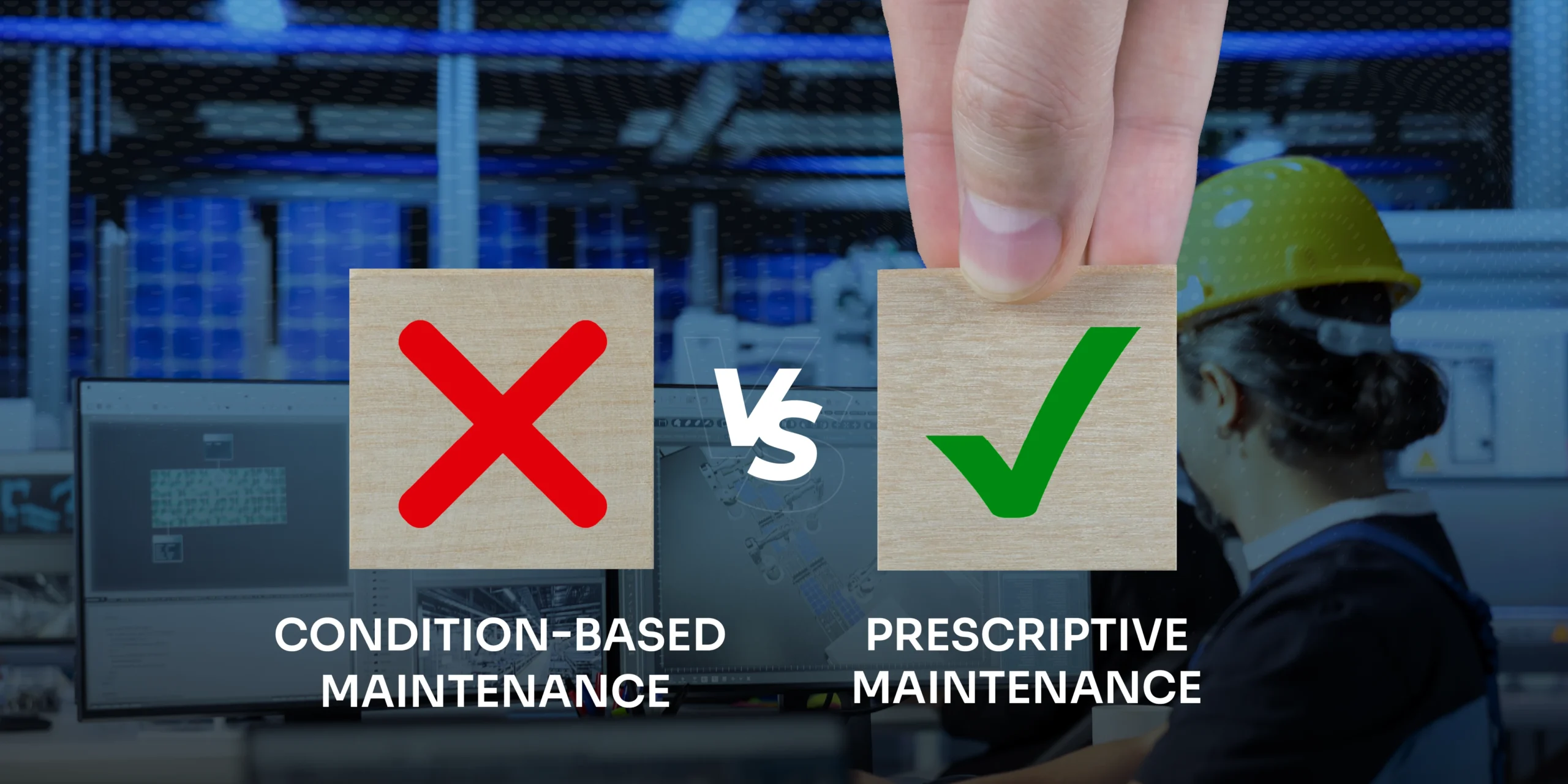
    Condition-Based Maintenance vs. Prescriptive Maintenance: Key Differences Explained

    Condition-Based Maintenance vs. Prescriptive Maintenance

    Read Time: 5–6 minutes | Author – Kalyan Meduri

    Condition-Based Maintenance vs. Prescriptive Maintenance: Key Differences

    As industrial operations become more complex and cost pressures increase, maintenance strategies are evolving beyond reactive and time-based approaches. Two commonly discussed modern strategies are Condition-Based Maintenance (CBM) and Prescriptive Maintenance. While both aim to reduce failures and improve reliability, they differ significantly in how decisions are made and how effectively downtime is prevented.Understanding these differences is essential for organizations looking to improve uptime, control costs, and move toward more stable, predictable operations.

    What Is Condition-Based Maintenance (CBM)?

    Condition-Based Maintenance is a proactive maintenance strategy where maintenance actions are triggered based on the current condition of equipment. Instead of following fixed schedules, CBM relies on real-time monitoring data to determine when maintenance is required.CBM typically monitors parameters such as:

      1. Vibration
      2. Temperature
      3. Pressure
      4. Lubrication quality
      5. Electrical current or load

    When a monitored parameter crosses a predefined threshold, maintenance is initiated.Example:

    If vibration levels on a motor exceed acceptable limits, maintenance teams are alerted to inspect or repair the asset before failure occurs.

    Key Characteristics of CBM 

      1. Reacts to the current health state of equipment
      2. Uses threshold-based alerts
      3. Prevents some unexpected failures
      4. Reduces unnecessary preventive maintenance

    CBM is effective for assets with well-understood failure modes and clear operating limits.

    Are Condition-Based Maintenance (CBM) and Online Condition Monitoring the same ?

    No. Condition-Based Maintenance (CBM) and Online Condition Monitoring are not the same.

    • CBM is a maintenance strategy—it decides when to perform maintenance based on asset condition.
    • Online Condition Monitoring is a technology/system—it provides continuous, real-time data about that condition.

    What Is Prescriptive Maintenance?

    Prescriptive Maintenance is an advanced maintenance approach that goes beyond detecting or predicting issues. It uses real-time data, historical data, advanced analytics, and AI to recommend specific maintenance actions, including what to do, when to do it, and how to prioritize actions.Rather than reacting to condition thresholds, Prescriptive Maintenance evaluates:

      1. Equipment condition
      2. Process behavior
      3. Energy consumption
      4. Operational context
      5. Risk and impact on production

    The outcome is a clear, actionable recommendation, not just an alert.Example:

    Instead of flagging only high vibration, a prescriptive system recommends:

    “1. Inspect & correct the coupling condition for any abnormal wear /looseness and reassess precision alignment between the motor & gearbox.

    2. Ensure proper & uniform tightness of all base fixing locations of the motor and improve the base rigidity if required.”

    – Prescription for a Banbury Mixer with a business impact of downtime savings of 16 hours post corrective actions, successfully implemented as prescribed.

    Key Differences Between Condition-Based and Prescriptive Maintenance

    Aspect Condition-Based Maintenance (CBM) Prescriptive Maintenance (RxM)
    Decision
    Trigger
    Maintenance is initiated when asset condition indicators cross predefined
    health limits or show clear deterioration, independent of business impact.
    Maintenance is initiated when models predict a specific failure mode,
    quantify its risk window, and link it to concrete business consequences
    such as downtime, safety, or quality loss.
    Primary
    Question
    “Is the asset healthy now, and do I need to intervene soon based on its
    current condition?”
    “What exactly should be done, by whom, and by when to avoid the predicted
    failure and its business impact?”
    Data
    and Context Usage
    Relies primarily on real-time sensor readings and periodic inspections,
    with limited consideration of load, product, or operating mode.
    Fuses real-time, historical, and contextual data (process conditions,
    recipes, schedules, environment, past work orders) to explain why the issue
    is emerging and what will happen if ignored.
    Analytics
    and Reasoning
    Uses thresholds, simple trends, and basic diagnostics; deeper interpretation
    and root-cause analysis are largely left to human experts.
    Uses advanced analytics and AI to identify failure modes, simulate future
    scenarios, and recommend the optimal set of actions with supporting rationale.
    Guidance and Actionability Generates alerts, alarms, and health indices that inform technicians
    something is wrong but do not specify the precise corrective steps.
    Delivers clear, prioritized prescriptions that define specific actions,
    timing, and expected impact on risk, downtime, and cost.
    Failure
    and Downtime Impact
    Reduces unexpected failures compared to reactive maintenance but can still
    lead to late, ambiguous, or non-prioritized interventions.
    Enables earlier, more targeted interventions that systematically cut
    unplanned downtime, repeat failures, and unnecessary maintenance work.
    Integration
    with Operations
    Primarily supports maintenance decision-making with limited integration
    into production planning or quality management.
    Aligns maintenance, operations, and planning by tying recommendations
    directly to production plans, process constraints, and business KPIs.

    Operational Impact of Condition-Based Maintenance

    Condition-Based Maintenance (CBM) represents a clear improvement over reactive maintenance by enabling teams to respond to equipment health issues before failure occurs. However, in complex industrial environments, its limitations often become apparent at scale.Because CBM relies heavily on threshold-based alerts, alerts can be frequent and ambiguous. A vibration or temperature alarm indicates that a parameter has crossed a limit, but it does not explain the severity, root cause, or urgency of the issue. As a result, teams may struggle to determine whether immediate action is required or if the condition can be safely monitored.CBM also places a significant interpretation burden on maintenance and operations teams. Reliability Engineers and technicians must manually analyze alarms, correlate them with operating conditions, and decide on the appropriate response. This decision-making process often depends on individual experience rather than standardized guidance, leading to inconsistent responses across shifts or sites.Because the risk and impact of an alert are not always clear, action is frequently delayed. Teams may choose to “wait and watch” to avoid unnecessary downtime, allowing degradation to progress. In other cases, alerts trigger early maintenance that may not be required, leading to over-maintenance, increased costs, and unnecessary production disruption.As a result, CBM can still allow critical issues to be addressed too late, while less critical issues consume maintenance resources. This imbalance limits the ability of CBM alone to deliver consistently stable and predictable operations.

    Operational Impact of Prescriptive Maintenance

    Prescriptive Maintenance is designed to overcome these limitations by shifting maintenance decisions from interpretation to guided execution. Instead of generating raw alerts, prescriptive systems evaluate equipment condition, process behavior, energy usage, and operational context together to determine the most effective action.By prioritizing issues based on risk and impact, Prescriptive Maintenance significantly reduces alert fatigue. Teams are no longer overwhelmed by multiple alarms of equal importance. Instead, they receive a smaller number of high-confidence recommendations focused on preventing the most critical failures.Prescriptive Maintenance also guides teams with clear, actionable recommendations. Rather than asking operators to interpret data, the system explains what action to take, when to take it, and why it matters. This improves consistency across shifts, reduces reliance on individual expertise, and enables faster, more confident decisions on the shop floor.Another key operational advantage is alignment with production planning. Prescriptive recommendations are designed to fit within planned shutdowns or low-impact windows, minimizing disruption to output while still preventing failures. This coordination between maintenance and operations reduces emergency work and improves schedule adherence.By addressing issues earlier and more precisely, Prescriptive Maintenance helps prevent secondary damage and cascading failures. Correcting root causes early reduces mechanical stress on connected equipment, stabilizes processes, and improves energy efficiency.Plants that adopt prescriptive approaches typically experience:

      1. Fewer unplanned stoppages and emergency interventions
      2. More predictable and effective maintenance planning
      3. Higher equipment availability and utilization
      4. More stable energy consumption and process behavior

    Over time, these improvements compound, leading to more reliable operations, lower operating costs, and greater confidence in day-to-day plant performance.

    Benefits of Prescriptive Maintenance Over Condition-Based Maintenance

    While Condition-Based Maintenance (CBM) improves reliability by responding to real-time equipment health, Prescriptive Maintenance delivers a higher level of operational control and decision confidence. It not only identifies issues, but also guides teams on the most effective actions to take.

    1.  Actionable Guidance Instead of Threshold Alerts

    CBM triggers alerts when predefined limits are crossed, leaving teams to interpret severity and next steps. Prescriptive Maintenance provides clear, prioritized recommendations, telling teams what to do, when to act, and why it matters, reducing ambiguity and delay.

    2.  Earlier Intervention and Better Failure Prevention

    Prescriptive Maintenance analyzes trends, risk, and impact—often identifying degradation before condition thresholds are breached. This enables earlier, targeted intervention and more effective prevention of failures.

    3.  Reduced Alert Fatigue

    CBM systems can generate frequent alerts of equal importance. Prescriptive Maintenance prioritizes issues based on operational and financial risk, allowing teams to focus only on what truly impacts uptime and safety.

    4.  Better Alignment with Production Planning

    Prescriptive recommendations are designed to fit within planned shutdowns or low-impact windows, minimizing production disruption. This improves coordination between maintenance and operations—something CBM alone cannot achieve.

    5.  Prevention of Secondary and Cascading Failures

    By addressing root causes early, Prescriptive Maintenance reduces mechanical stress on connected assets, stabilizes processes, and prevents secondary damage—extending overall equipment life.

    6.  Greater Impact on Uptime and Cost Control

    Plants using Prescriptive Maintenance typically achieve fewer unplanned stoppages, higher equipment availability, and lower maintenance and energy costs compared to CBM-based approaches.

    7.  Scalable Across Complex Operations

    As asset complexity and data volume increase, CBM becomes harder to manage. Prescriptive Maintenance scales effectively by using AI to process large data sets and guide decisions at scale.

    8.  Addressing Process-Induced Faults

    Prescriptive Maintenance links equipment behavior with process conditions like load, speed, and other variables to detect when operations are inducing faults, then prescribes both mechanical fixes & process changes to remove the underlying stress & prevent repeat failures.

    Conclusion: Which Strategy Is Right for You?

    Condition-Based Maintenance represents a critical step beyond reactive maintenance by enabling real-time responses to equipment reliability. It helps prevent some failures and reduces unnecessary maintenance, but it still relies heavily on human interpretation and reacts after degradation becomes visible.Prescriptive Maintenance represents a more advanced and scalable approach. By combining equipment condition, process behaviour, and operational context, it not only identifies risks but also guides action with clarity and confidence. Clear recommendations on what to do, when to act, and why it matters allow teams to intervene earlier, reduce downtime more effectively, and maintain stable operations.Infinite Uptime’s PlantOS™ Manufacturing Intelligence is the world’s most user‑validated Prescriptive AI platform for heavy and process industries, trusted across 844 global plants. With 99.97% prediction accuracy, 99% prescription adoption, and 100% user‑validated outcomes, PlantOS™ delivers measurable reliability at scale. In an environment where MIT study shows 95% of AI pilots fail due to lack of adaptability and real workflow integration, PlantOS™ closes this credibility and outcomes gap through its 99% Trust Loop—a continuously learning feedback system where every user‑validated prescription is digitally verified and fed back to strengthen future recommendations.

    By ingesting equipment, process, and energy data, PlantOS™ contextualizes insights in under two weeks and delivers “3 Outcomes in 1 Prescription with 0 Guesswork”—aligning uptime, energy efficiency, and throughput for all outcome champions, from maintenance and process teams to C‑suite executives.

    Explore how PlantOS™ can transform your maintenance strategy—experience the world’s most trusted Prescriptive AI platform and achieve outcomes you can measure.

    The 99% Trust Loop

    Find out how ‘The 99% Trust Loop’ @PlantOS™ delivered 3 User Validated Outcomes in 1 Prescription:https://youtu.be/SoEsZ5XF0ig

    Read more Blogs
  • Why Cement Gearboxes Fail More Often in Q4

    Why Cement Gearboxes Fail More Often in Q4

    Why Cement Gearboxes Fail More Often in Q4

    Read Time: 5–6 minutes | Author – Kalyan Meduri

    Why Cement Gearboxes Fail More Often in Q4

    Cement gearbox failures spike in Q4 due to sustained overloads, thermal stress, lubrication breakdown, and deferred maintenance during peak U.S. demand cycles. As plants push equipment harder to meet year-end construction and budget deadlines, early warning signs are often missed. Sensing-driven maintenance enables early detection of gearbox degradation and helps prevent costly unplanned downtime during the most critical production period of the year.

    Key Takeaways

    01
    Cement gearbox failures increase in Q4 due to peak U.S. construction demand and extended high-load operation 02
    Sustained torque, thermal stress, and lubrication breakdown accelerate wear during year-end production surges 03
    Deferred maintenance decisions made to “get through Q4” significantly raise failure risk 05
    Sensing-driven maintenance provides continuous visibility, contextual insights, and actionable guidance to prevent unplanned downtime 04
    Traditional time-based and alarm-only maintenance approaches often miss early warning signs

    The Q4 Cement Demand Surge in the U.S.

    For cement producers in the United States, Q4 is one of the most demanding periods of the year. As construction projects race to finish before winter weather and fiscal-year deadlines, plants operate closer to nameplate capacity for extended periods. This seasonal surge increases stress on critical rotating equipment, especially gearboxes that run continuously under high load, heat, and dust exposure. While the demand cycle is predictable, the resulting failure patterns often catch plants off guard.

    Why Gearboxes Are Especially Vulnerable in Q4

     Sustained Overloading and Torque Stress 

    During Q4, gearboxes are subjected to higher throughput targets, longer run times, and fewer planned shutdowns. Sustained torque loads accelerate wear on gear teeth, bearings, and shafts, pushing components past fatigue thresholds that may not be reached earlier in the year.

    Thermal Stress from Ambient and Process Heat 

    Cement operations already generate extreme heat. In Q4, thermal stress compounds due to aging cooling systems, insulation degradation, and increased friction from higher loads. Elevated temperatures reduce lubricant effectiveness and increase the likelihood of surface damage inside the gearbox.

    Lubrication Breakdown and Contamination 

    Lubrication-related issues are a leading cause of gearbox failure in cement plants, and Q4 conditions amplify the risk. Oils degrade faster under sustained heat, dust ingress increases during peak production, and seasonal weather shifts raise the likelihood of moisture contamination. Once lubrication integrity is compromised, gear pitting and bearing damage progress rapidly.

    Deferred Maintenance Decisions 

    Under pressure to maintain output, maintenance teams are often instructed to delay inspections or repairs until after the end of the year. Minor gearbox issues that could have been resolved earlier become catastrophic failures when ignored during sustained high-load operation.

    Early Warning Signs That Are Commonly Missed

    Most Q4 gearbox failures do not occur without warning. Common early indicators include rising vibration levels at gear mesh frequencies, abnormal temperature trends, acoustic emissions from micro-cracks, and efficiency losses masked by higher throughput. Without continuous sensing, these warning signs are easily overlooked until failure is imminent.

    Why Traditional Maintenance Approaches Fall Short in Q4

    Calendar-Based Maintenance Lacks Context

    Time-based maintenance schedules do not account for seasonal demand, load variability, or cumulative stress. A gearbox inspected in late summer may deteriorate significantly by November under Q4 operating conditions.

     Infrequent Manual Inspections 

    Q4 production schedules leave little room for manual inspections or extended shutdowns. By the time inspections occur, internal damage is often too advanced to repair economically.

    Alert Fatigue from Basic Monitoring 

    Alarm-only condition monitoring systems generate alerts without prioritization or context. In high-pressure Q4 environments, teams struggle to determine which alerts require immediate action and which can be deferred.

    How Sensing-Driven Maintenance Prevents Q4 Gearbox Failures

    Continuous Gearbox Health Visibility Advanced sensing technologies provide real-time data on vibration, temperature, and acoustic behavior. This enables early detection of micro-failures before damage escalates into unplanned downtime.

    Contextualized Insights for Confident Decisions

    Sensing-driven maintenance systems translate raw sensor data into actionable insights, identifying which gearboxes are at risk, why degradation is occurring, and when intervention is required. This context is critical during Q4, when maintenance decisions must be fast and precise.

    Maintenance That Aligns with Production Reality

    With clear, prioritized guidance, teams can plan targeted interventions during short maintenance windows, replace components before catastrophic failure, and avoid unnecessary shutdowns. Instead of choosing between uptime and reliability, sensing-driven maintenance aligns both objectives.

    The Business Impact of Preventing Q4 Gearbox Failures

    Preventing gearbox failures during Q4 delivers outsized returns because downtime costs are highest during peak demand. Plants that maintain gearbox reliability benefit from reduced unplanned downtime, lower repair costs, stable throughput, and improved maintenance confidence under pressure.

    Preparing Gearboxes for Q4 Starts Earlier Than You Think

    The most reliable cement plants prepare for Q4 months in advance. By establishing gearbox health baselines in Q2 and Q3 and monitoring stress accumulation as demand increases, teams can enter Q4 with confidence rather than risk.

    Final Thoughts

    Cement gearbox failures spike in Q4 not because the equipment is flawed, but because demand pressure, thermal stress, lubrication challenges, and deferred maintenance converge at once. Sensing-driven maintenance provides the visibility and insight needed to prevent failures when the cost of downtime is highest, turning Q4 from a season of risk into a period of operational strength.

    The 99% Trust Loop

    Find out how ‘The 99% Trust Loop’ @PlantOS™ delivered 3 User Validated Outcomes in 1 Prescription:https://youtu.be/SoEsZ5XF0ig

    Ready to prevent gearbox failures before they happen?


    See how Infinite Uptime gives cement plants early visibility into gearbox risk, so teams can act before Q4 demand turns minor issues into major downtime.


    Talk to our team to understand how this approach fits your plant’s operating reality.


    Talk to an Outcomes Expert

    A friendly light-blue cartoon robot with a round head and screen face showing glowing green eyes stands upright, featuring a chest circuit-board icon above the Infinite Uptime infinity logo

  • Prescriptive vs Predictive Maintenance

    Prescriptive vs Predictive Maintenance

    Prescriptive vs Predictive Maintenance: What’s the Difference?

    Read Time: 5–6 minutes | Author – Kalyan Meduri

    difference between predictive and prescriptive maintenance

    Prescriptive vs predictive maintenance refers to two different industrial maintenance strategies. Predictive maintenance uses condition monitoring and predictive analytics to estimate when equipment is likely to fail, while prescriptive maintenance goes further by recommending what actions to take, when to take them, and why to prevent failure. Prescriptive maintenance uses prescriptive AI, operational context, and outcome feedback loops, such as Infinite Uptime’s 99% Trust Loop, to ensure recommendations are trusted, acted upon, and continuously validated, resulting in higher reliability, reduced unplanned downtime, and measurable ROI.

    Key Takeaways

    01
    Predictive maintenance forecasts failures; prescriptive maintenance prevents them02
    Prescriptive maintenance closes the gap between insight and action
    03
    Predictive programs often stall due to alert fatigue and decision overload05
    The future of industrial maintenance is prescriptive, not predictive 04
    Prescriptive AI delivers higher action rates and measurable ROPredictive and prescriptive maintenance are often grouped together, but they are not the same. While predictive maintenance focuses on forecasting failures, prescriptive maintenance goes further by recommending exactly what actions to take, when to take them, and why making it the more advanced and outcome-driven maintenance strategy. Why This Comparison Matters More Than Ever Unplanned downtime remains one of the most expensive challenges in industrial operations. As manufacturers adopt AI-driven maintenance strategies, many assume predictive maintenance is the end goal. In reality, predictive maintenance is only a stepping stone toward prescriptive maintenance, which closes the gap between insight and action. What separates successful programs from stalled pilots is trust. Without confidence in AI recommendations, teams hesitate to act. Prescriptive maintenance frameworks like Infinite Uptime’s 99% Trust Loop ensure that AI insights are not only accurate but consistently executed and validated by real-world outcomes. Understanding the difference directly impacts:

    • Downtime reduction
    • Maintenance costs
    • Asset reliability
    • ROI from industrial AI investments

    What Is Predictive Maintenance?

    Predictive maintenance uses historical and real-time data to predict when equipment is likely to fail. It relies on condition monitoring techniques such as vibration analysis, temperature tracking, oil analysis, and machine learning models to detect early warning signs.

    Key Characteristics of Predictive Maintenance

    • Focuses on when a failure may occur 
    • Identifies abnormal conditions or degradation patterns 
    • Triggers alerts or warnings 
    • Requires human interpretation and decision-making 

    Predictive maintenance answers the question: 
    “What is likely to fail, and when?” 

    Common Predictive Maintenance Technologies

    • Vibration monitoring 
    • Thermal imaging 
    • Acoustic sensors 
    • Oil and lubricant analysis 
    • Predictive analytics models 

    These tools are powerful, but they often generate large volumes of alerts, many of which never result in action. 

    What Is Prescriptive Maintenance?

    Prescriptive maintenance builds on predictive maintenance by adding decision intelligence. Instead of stopping at detection, it analyzes multiple variables and prescribes the best course of action to prevent failure. 

    Prescriptive maintenance answers a more critical question:
    “What should we do right now to prevent failure and achieve the best outcome?”

    How Prescriptive Maintenance Works

    Prescriptive maintenance systems: 

    • Combine sensor data, operational context, and historical outcomes
    • Apply prescriptive AI models and domain expertise
    • Prioritize risks based on business impact
    • Recommend specific corrective actions
    • Continuously learn from outcomes

    Prescriptive maintenance ensures that recommendations are acted on, validated, and continuously improved, turning AI insights into trusted operational decisions.

    Prescriptive vs Predictive Maintenance at a Glance

    Feature Predictive Maintenance Prescriptive Maintenance
    Primary Goal Predict failures Prevent failures with action
    Focus Detection and forecasting Decision and execution
    Output Alerts and predictions Actionable recommendations
    Human Effort High (interpretation required) Reduced (guided actions)
    Business Impact Variable Measurable and repeatable
    ROI Confidence Inconsistent High

    Limitations of Predictive Maintenance

    While predictive maintenance is valuable, it has clear limitations:

    Alert Fatigue

    Too many alerts with unclear urgency lead to inaction.

    Pilot Paralysis

    Teams struggle to scale predictive pilots into enterprise-wide programs.

    Predictions still require expert interpretation, slowing response times.

    Unclear ROI

    If predictions are not acted upon, failures still occur.

    This is where many predictive maintenance programs stall.

    Why Prescriptive Maintenance Delivers Better ROI

    Prescriptive maintenance directly addresses the gaps left by predictive approaches.

    Key Advantages

    • Prioritized actions tied to business impact 
    • Higher action rates on AI insights 
    • Faster decision-making 
    • Reduced dependency on scarce experts 
    • Proven reduction in unplanned downtime 

    By closing the loop between prediction, prescription, and execution, prescriptive maintenance—supported by the 99% Trust Loop – delivers consistent, auditable ROI instead of theoretical value.

    Real-World Use Cases

    Predictive Maintenance Use Cases

    • Monitoring asset health trends
    • Identifying early degradation
    • Supporting condition-based maintenance

    Prescriptive Maintenance Use Cases

    • Preventing catastrophic gearbox and bearing failures
    • Optimizing maintenance schedules
    • Reducing energy waste linked to equipment inefficiencies
    • Standardizing best practices across plants

    Prescriptive Maintenance and the Future of Industrial AI

    As industrial AI matures, the market is shifting from:

    • Dashboards → Decisions
    • Predictions → Prescriptions
    • Insights → Outcomes

    Prescriptive maintenance is the foundation for semi-autonomous and autonomous operations, where systems don’t just inform humans, they actively guide them toward the best outcome with measurable confidence and trust.

    Which Maintenance Strategy Is Right for You?

    Predictive maintenance is a strong starting point, but it is not the destination. Organizations serious about reliability, cost control, and scalable AI adoption are moving toward prescriptive maintenance to ensure insights actually translate into action. If your team is asking:

    • “Which alerts matter most?”
    • “What should we fix first?”
    • “How do we prove ROI from AI?”

    You’re already looking for prescriptive maintenance.

    The 99% Trust Loop

    Find out how ‘The 99% Trust Loop’ @PlantOS™ delivered 3 User Validated Outcomes in 1 Prescription:https://youtu.be/SoEsZ5XF0ig

    Move Beyond Predictions. Start Driving Outcomes.


    Learn how prescriptive maintenance transforms reliability programs by turning AI insights into trusted, prioritized actions, validated through Infinite Uptime’s 99% Trust Loop. Contact an Infinite Uptime outcomes expert today.


    Contact Us

    A friendly light-blue cartoon robot with a round head and screen face showing glowing green eyes stands upright, featuring a chest circuit-board icon above the Infinite Uptime infinity logo

  • The U.S. Steel Plant Reliability Crisis

    The U.S. Steel Plant Reliability Crisis

    The U.S. Steel Plant Reliability Crisis

    Read Time: 5–6 minutes | Author – Kalyan Meduri

    This blog breaks down what is driving the steel reliability squeeze, which failure modes matter most, and how a 99% Trust Loop mindset shifts reliability from “alerts” to “outcomes.”

    Key Takeaways

    01
    U.S. steel plant reliability is under pressure from harsh operating conditions and aging assets
    02
    Steel mill downtime is commonly driven by lubrication issues, bearing failures, and gearbox reliability problems
    03
    Predictive maintenance and condition monitoring alone are not enough
    04
    Prescriptive maintenance improves decision making and execution
    05
    The 99% Trust Loop connects detection, action, and validation
    U.S. steel plant reliability is facing a real crisis. Aging infrastructure, extreme operating conditions, and increasing production pressure have made steel mill downtime more frequent and more costly. For plant managers, reliability is no longer a background maintenance issue. It is a core operational risk that directly impacts throughput, safety, and margin.
    Steel plants operate some of the most punishing assets in North American manufacturing. Continuous duty cycles, extreme heat, vibration, dust, scale, and water exposure accelerate wear across rolling mills, gearboxes, bearings, and auxiliary systems. When steel plant maintenance programs fall behind, the result is cascading downtime across the entire operation.The problem is that reliability has become harder to protect at exactly the time steel leaders need it most. Energy costs, margin pressure, and customer delivery expectations have raised the penalty of downtime. Public disclosures in the sector show how real these events are, including unplanned outages that force operational workarounds to recover production volume.At the broader manufacturing level, downtime is increasingly being framed as an enterprise risk rather than an inconvenience. A 2025 survey cited by Fluke reported major capital impacts tied to unplanned downtime and frequent incident rates among manufacturers.

    Why steel reliability is uniquely fragile

    Most steel plants already use historians, PLC data, vibration routes, and condition monitoring systems. The issue is not visibility. The issue is execution.
    U.S. steel plant reliability is uniquely fragile because:

    • Assets are tightly coupled. A single gearbox or bearing failure can stop an entire rolling mill.
    • Operating conditions accelerate degradation. Heat and contamination attack lubrication systems and seals, while vibration increases fatigue.
    • Maintenance windows are constrained. Narrow outages force teams to delay corrective work.
    • Alert fatigue erodes trust. When condition monitoring produces false positives, teams hesitate to act.

    In high-duty gearbox applications, even “small” internal components can cause outsized consequences. An AIST technical article on gearbox reliability highlights that bearings may be a small portion of gearbox cost, but can drive major production losses when premature damage removes a gearbox from service unexpectedly.

    The most common failure drivers in steel plants

    Steel mill downtime rarely comes from a single sudden event. Most failures follow a predictable chain that can be addressed through prescriptive maintenance.

    Lubrication breakdown and contamination

    High temperatures, water ingress, and particulate contamination reduce oil film strength and accelerate wear.

    Bearing failures and misalignment

    Thermal growth, soft foot, and alignment drift increase bearing loads, driving vibration and temperature increases.

    Gearbox reliability degradation

    As bearing condition deteriorates, gear mesh patterns degrade. Debris circulates through the lubrication system, accelerating damage.

    Rolling mill reliability loss

    Before catastrophic failure, rolling mills experience speed reductions, thickness variation, scrap increases, and forced slowdowns.These failure modes are common across steel plant maintenance programs that rely only on reactive or predictive approaches.

    Why traditional “predictive maintenance” often stalls in steel

    Many steel producers have invested heavily in predictive maintenance and condition monitoring tools. Yet steel mill downtime persists.
    Two issues consistently limit results:

    • Low actionability. Alerts identify problems but do not prescribe what to do next.
    • Low trust. False positives and unclear root causes delay decisions.

    As a result, steel plant maintenance teams continue to rely on reactive repairs and emergency work orders.

    How prescriptive maintenance improves steel plant reliability

    Prescriptive maintenance goes beyond predicting failure. It provides clear, prioritized guidance on what action to take and when.In steel environments, prescriptive maintenance:

    • Connects condition monitoring signals to specific failure modes
    • Recommends prioritized corrective actions
    • Aligns maintenance work with production schedules
    • Validates that interventions prevented downtime

    This approach is delivered through the PlantOS™ prescriptive AI platform, which is designed for harsh industrial environments like steel.

    The 99% Trust Loop approach for steel reliability

    The 99% Trust Loop ensures that prescriptive maintenance insights lead to real outcomes.In practice, the Trust Loop works by:

    1. Detecting early failures with high confidence using condition monitoring
    2. Prescribing the next best maintenance action
    3. Validating outcomes to confirm risk reduction

    By closing this loop, steel plant maintenance teams move from alert monitoring to reliability ownership.

    What plant managers should prioritize first

    Plant managers focused on improving U.S. steel plant reliability should prioritize:

    Critical assets that stop production

    Rolling mill drives, main gearboxes, cranes, and casters that create immediate steel mill downtime when they fail.

    Failure modes with long lead times

    Bearing failures, lubrication degradation, and gearbox wear that can be detected weeks in advance.

    Execution over inspection

    Programs must convert insights into planned work using prescriptive maintenance, not just inspection reports.

    The 99% Trust Loop

    Find out how ‘The 99% Trust Loop’ @PlantOS™ delivered 3 User Validated Outcomes in 1 Prescription:https://youtu.be/SoEsZ5XF0ig

    If your reliability program is generating alerts but not outcomes, it is time to close the loop.


    Talk to Infinite Uptime about deploying

    PlantOS™

    in steel environments to improve trust, accelerate maintenance decisions, and reduce unplanned downtime.


    Talk to Us

    A friendly light-blue cartoon robot with a round head and screen face showing glowing green eyes stands upright, featuring a chest circuit-board icon above the Infinite Uptime infinity logo

  • الصيانة التوجيهية في قطاع التعدين السعودي: تعظيم العائد على الاستثمار في مشاريع رؤية 2030

    الصيانة التوجيهية في قطاع التعدين السعودي: تعظيم العائد على الاستثمار في مشاريع رؤية 2030

    الصيانة التوجيهية في قطاع التعدين السعودي: تعظيم العائد على الاستثمار في مشاريع رؤية 2030

    وقت القراءة: 5-6 دقائق |مؤلف – كاليان ميدوري معدل تنفيذ توجيهات يصل إلى %99% من خلال تجاوز مجرد التنبيهات التقليدية للاهتزاز إلى اتخاذ PlantOS تقدم منصة (Trust Loop إجراءات يتحقق منها المستخدم. يوضح هذا المقال كيف تغلق الذكاء الاصطناعي التوجيهي” حلقة الثقة لعمليات التعدين السعودية، محولة الثروة المعدنية للمملكة البالغة 2.5 تريليون دولار إلى نتائج إنتاجية موثقة

    نهضة التعدين: من الاستكشاف إلى المعالجة

    يتسارع قطاع التعدين في اللهملكة العربية السعودية ليصبح الركيزة الاقتصادية الرئيسية التالية للمملكة. مع ثروة معدنية تقدر ب
    2.5 تريليون دولار، مثل عام 2025 عاماً محورياً للاستكشاف والترخيص. وقد استقطبت جولات الترخيص الكبرى – التي
    و”هانكوك، (Vedanta) “غطت 4,788 كيلومتراً مربعاً في مواقع جبل صايد والحجر – عمالقة عالميين مثل “فيدانتا
    بالتزامات استكشافية إجمالية بلغت 97.6 ،(Zijin Mining) “و”زيجين للتعدين، (Hancock Prospecting) “بروسبكتينج
    .مليون دولاربينما تمضي المملكة قدماً نحو تحقيق أهداف رؤية 2030، من المتوقع أن يساهم القطاع بأكثر من 75 مليار دولار في الناتج
    المحلي الإجمالي ويوفر 250,000 فرصة عمل. ومع ذلك، ومع تدفق الاستثمارات في رواسب النحاس والزنك والذهب
    والفضة، يظهر تحدٍ تقني؛ ففي البيئات القاسية في الرياض والجبيل ومواقع الصحراء النائية، غالباً ما تفشل أنظمة المراقبة
    التقليدية. ولتحقيق النجاح، يجب على مشغلي التعدين السعوديين تجاوز “مرحلة التجارب المحدودة” وتبني العمليات شبه الذاتية
    .التي تضمن استمرارية التشغيل من خلال الذكاء الاصطناعي الصناعي المتقدم

    لماذا تفشل 95% من مشاريع الذكاء الاصطناعي الصناعي التجريبية؟

    من معهد NANDA على الرغم من “طفرة” الاستثمار، يواجه قادة التصنيع والتعدين حقيقة قاسية. وفقاً لأبحاث مبادرة
    فإن 95% من مشاريع الذكاء الاصطناعي التجريبية تفشل في تحقيق نتائج مالية سريعة.،(MIT) ماساتشوستس للتكنولوجيا
    .”وفي سياق التعدين السعودي، “الغبار والحرارة لا ينتظران تحليل البياناتالمشكلة الأساسية لا تكمن في جودة نماذج الذكاء الاصطناعي، بل في “فجوة التعلم”. توفر معظم المنصات “تنبيهات تنبؤية”
    فقط – وهي قائمة من الاحتمالات التي تترك فرق الصيانة والطاقة والعمليات غارقة في لوحات البيانات و”إطفاء الحرائق”
    الناتجة عن إنذارات غير موثقة. عندما يحدد الذكاء الاصطناعي خطأ ما ولكنه لا يقدم حلاً محدداً وموثوقاً، تتآكل ثقة المشغل.
    البيانات دون اتخاذ إجراء هي مجرد عدم كفاءة. بالنسبة لقطاع يتوسع بسرعة قطاع التعدين في المملكة، فإن نقص الاعتماد هذا
    .يمثل عنق زجاجة بمليارات الدولارات

    (The 99% Trust Loop)”%و”حلقة الثقة 99 PlantOSM تقديم

    ليست مجرد بائع برمجيات؛ نحن شريك كامل في الذكاء الاصطناعي التوجيهي لنتائج التصنيع شبه Infinite Uptime إن
    على سد الفجوة بين البيانات الخام والعائد على الاستثمار الموثق. فهي لا تكتفي بالقول، PlantOST ،الذاتية. تعمل منصتنا
    :”هناك اهتزاز عالٍ”، بل تقدم توجيهاً واضحاً وقابلاً للتفسيرخلال الـ 48 ساعة (B) تم اكتشاف اختلال في المحاذاة في الكسارة الأولية. قم بمحاذاة المحرك”
    “.القادمة لمنع توقف غير مخطط له لمدة 6 ساعات؟PlantOSTM لماذا يثق المشغلون في:المركز الأول عالمياً في ثلاثة مقاييس حاسمة PlantOST في قطاع الصناعات الثقيلة، تُكتسب الثقة من خلال الدقة. تتبوأ

    • إ(دقة تنبؤ بنسبة 99.97%: (معدل سلبى كاذب قدره 0.03% فقط
    • .معدل اعتماد التوجيهات بنسبة 99%: يتفاعل المشغلون لأن البيانات تم فحصها وهي ذات صلة مباشرة
    • .نتائج موثقة من المستخدم بنسبة 100%: يتم التحقق من كل نتيجة رقمياً من قبل الشخص الموجود في الموقع

    حتى أواخر عام 2025، شهدت 529 من أصل 831 محطة عالمياً صفر حالات سلبية كاذبة في آخر 12 شهراً. هذا ليس مجرد
    .تسويق، بل هو أداء مثبت رياضياًتحويل الرؤى إلى ذهبلتحقيق الأهداف الطموحة التي حددها برنامج تطوير الصناعة الوطنية والخدمات اللوجستية (ندلب)، يحتاج قطاع التعدين
    السعودي إلى نظام يتعلم من بيئته الخاصة. “حلقة الثقة 99%” هي إطار عملنا المملوك المكون من 4 خطوات والذي يضمن
    إعدم ضياع أي تنبيه01
    سياق البيانات المتقدم

    على عكس المنافسين الذين يستغرقون شهوراً للدمج، نقوم باستيعاب ووضع بيانات المعدات والعمليات والطاقة في سياقها
    الصحيح في أقل من 3 أسابيع. في جولات الترخيص السعودية سريعة الوتيرة، يعد هذا الوقت السريع لتحقيق القيمة أمرأ
    .ضرورياً02
    دقة تنبؤ هي الأفضل في فئتها
    وإزالة تشكيل الموجة،FFT) الخاصة بنا بين التحليلات القائمة على الفيزياء (Onion Model) “تجمع بنية “نموذج البصلة
    الصدمية) والذكاء الاصطناعي القابل للتفسير. يكتشف هذا الأعطال الميكانيكية والكهربائية والناتجة عن العمليات قبل وقت
    إطويل من أن تؤدي إلى تعطل كامل04
    نتائج قابلة للتحقق رقمياً
    نغلق حلقة التغذية الراجعة من خلال تسجيل توثيق المشغل، والطابع الزمني، والتأثير المحدد (مثل ساعات التوقف التي تم
    توفيرها). وهذا يخلق سلسلة من الثقة قابلة للتدقيق يمكن للمديرين الماليين ورؤساء المحطات استخدامها لتبرير المزيد من
    .الاستثمار03
    اعتماد منقطع النظير للتوجيهات
    عندما يكتسب الذكاء الاصطناعي الثقة من خلال الدقة، يتخذ المشغلون الإجراءات اللازمة. في الربع الثاني من عام 2025،
    بلغت نسبة تنفيذ التوجيهات الخاصة بنا 99%. هذه هي “المصافحة الرقمية” التي تنقل المنشأة من الاستجابة للأزمات إلى
    .الصيانة الاستراتيجية

    Vedanta Spark x Infinite Uptime:دراسة حالة

    وهي لاعب رئيسى في توسع التعدين السعودي – تظهر قوة هذه – (Vedanta Group) شراكتنا مع مجموعة فيدانتا
    :حققنا،(Hindustan Zinc) “التكنولوجيا في العمل. في مناجم ومصاهر شركة ” هندوستان زنك

    • نشر أكثر من 1700 مستشعر عبر أكثر من 370 آلة حرجة
    • .توفير مباشر قدره 700,000 دولار من خلال الصيانة التوجيهية في الوقت الفعلي
    • .كسب أكثر من 650 ساعة من وقت تشغيل الآلات
    • .القضاء على التوقفات غير المخطط لها: دفع المنشأة نحو مستقبل شبه ذاتي التشغيل

    هذا التحول هو المخطط للمستثمرين الجدد الذين يدخلون سلسلة قيمة المعادن في المملكة العربية السعودية. سواء كنت تعمل في
    .يضمن توافق أدائك التشغيلي مع طموحك الاستثماري “Show & Grow” مراحل المعالجة أو التصنيع النهائي، فإن نموذج

    الركائز الثلاث للربحية

    بالنسبة للمستثمرين العالميين الذين يستفيدون من الملكية الأجنبية بنسبة 100% وتمويل رأسمالي يصل إلى 75% عبر
    :تأثيراً متزامناً عبر ثلاث ركائز PlantOST صندوق التنمية الصناعية السعودي، تقدم

    1. الموثوقية المضمونة (تقليل المخاطر): تحقيق موثوقية للمعدات بنسبة 99.7% على جميع الأصول المراقبة،
      .والانتقال من ضغوط رد الفعل إلى التخطيط الاستراتيجي
    2. زيادة الإنتاجية (تسريع الإيرادات): تحديد الانحرافات في العمليات التي تبطئ الإنتاج، مما يرفع معدلات الاستخدام
      .%بنسبة تصل إلى 2.5
    3. كفاءة الطاقة والاستدامة: خفض تكاليف التشغيل المتغيرة مع تقليل استهلاك الطاقة بنسبة تصل إلى 2% لكل طن
      .منتج، مما يدعم بشكل مباشر متطلبات الاستدامة في المملكة

    لا تشترِ برمجيات .. بل اشتر نتائج موثقة

    مستقبل التعدين السعودي ليس ذاتياً بالكامل؛ بل هو شبه ذاتي، حيث يوفر الذكاء الاصطناعي التوجيهات ويقوم البشر بالتحقق
    من التنفيذ. في صناعة تفشل فيها 95% من المشاريع التجريبية، تعد “حلقة الثقة 99%” هي المسار المستدام الوحيد للمضي
    .قدماًجاهزة لتكون شريكك في الذكاء الاصطناعي التوجيهي في المملكة. نحن لا نقدم مجرد لوحات بيانات؛ Infinite Uptime إن
    .نحن نقدم طبقة “التشخيص كخدمة” التي تضمن وصول محطتك إلى أهدافها في كل نوبة عمل

    الأسئلة الشائعة: الذكاء الاصطناعي التوجيهي والتعدين السعودي


    مع الحرارة والغبار الشديدين في مواقع التعدين السعودية؟ PlantOSTM س1: كيف تتعامل


    مستشعراتنا الصناعية المتينة والخاصة بنا مصممة لأقسى البيئات في العالم. وهي مصنفة لتحمل درجات حرارة تصل إلى 150
    درجة مئوية ويمكنها مراقبة المعدات التي تعمل بسرعة منخفضة تصل إلى 2 دورة في الدقيقة، مما يضمن الموثوقية حيث
    .تفشل المستشعرات القياسية


    الحالية؟ ERP أو SCADA س2: هل التكامل صعب مع أنظمة


    مستقلة عن نوع المستشعرات وجاهزة للربط. عادةً ما نحقق السياق الكامل للبيانات في غضون 2-3 PlantOSTM لا. منصة
    .أسابيع، مما يجعلها الحل| الأسرع في النشر في مجال الذكاء الاصطناعي الصناعي


    لمنشأة تعدين؟ (ROI) س3: ما هو العائد النموذجي على الاستثمار


    يرى معظم عملائنا عائداً على الاستثمار في غضون أسابيع وليس سنوات. مع فترة استرداد نموذجية تتراوح بين 6 إلى 12
    .شهراً، فإن التوفير الناتج عن التوقفات الملغاة وتقليل استهلاك الطاقة غالباً ما يغطي تكلفة التنفيذ بالكامل خلال العام الأول


    س4: كيف يدعم هذا أهداف الاستدامة في رؤية 2030؟


    شركات التعدين PlantOST من خلال تحسين كفاءة العمليات وتقليل استهلاك الطاقة لكل طن بنسبة تصل إلى 2%، تساعد
    .على تلبية أهداف كفاءة الطاقة والبيئة الصارمة التي تفرضها المملكة

  • Industrial AI in Saudi Arabia: Securing Vision 2030 Asset Reliability with The 99% Trust Loop

    Industrial AI in Saudi Arabia: Securing Vision 2030 Asset Reliability with The 99% Trust Loop

    Industrial AI in Saudi Arabia: Securing Vision 2030 Asset Reliability with The 99% Trust Loop

    Read Time: 5–6 minutes | Author – Kalyan Meduri A factory worker wearing an orange hard hat and safety glasses interacts with a glowing, holographic digital interface in a high-tech manufacturing plant. An orange robotic arm stands in the background, and the air is filled with shimmering digital data points and light effects. The worker is viewed from the side, appearing to touch or manipulate the virtual screens hovering over a production line.

    The realization of Saudi Vision 2030 hinges on operational excellence across its giga-projects and manufacturing sectors. Achieving this requires moving beyond passive machine monitoring to a system that guarantees verified outcomes. Infinite Uptime’s PlantOS™ delivers a 99% implementation rate on maintenance recommendations by converting generic sensor alerts into trusted, precise, and actionable Prescriptions. This approach eliminates the ‘Trust Gap’ that plagues traditional predictive maintenance tools, providing industrial leaders in Riyadh, Jubail, and across the Kingdom with the operational certainty necessary to meet aggressive efficiency targets.

    When Sensors Become Noise in the Desert Heat

    The Kingdom of Saudi Arabia is executing the most ambitious industrial transformation plan in modern history. The National Industrial Development and Logistics Program (NIDLP) and the mandates of Vision 2030 require a step-change in efficiency, utilization, and asset availability. This demands advanced industrial intelligence, yet many plants in the Kingdom remain trapped in the cycle of “Prediction, but not Prevention”.

    Why Passive Monitoring Fails the Vision 2030 Test

    You have invested in digital transformation. You have proprietary sensors installed on mission-critical rotating assets like pumps, compressors, and turbines. You have dashboards glowing with data streams. But the machines still fail. This contradiction is the Broken Promise of first-generation Predictive Maintenance (PdM).

    The core issue is simple: Prediction alone is passive. A warning that reads “High Vibration on Motor A” is not a solution; it is a problem that requires an engineer to spend hours confirming, diagnosing, and planning the fix. This delay is unacceptable under the demanding schedules of Vision 2030 projects.

    The Regional Nuance in KSA exacerbates this problem dramatically:

      1. Extreme Climate Load: The intense heat, persistent dust, and high humidity in industrial hubs like Jubail and Yanbu place unique stresses on machinery. These conditions accelerate failure modes (e.g., thermal expansion, bearing contamination), giving maintenance teams less time to react. Generic sensors often fail to maintain accuracy or are overwhelmed by environmental noise.
      2. The Skilled Labor Bottleneck: High-growth nations like Saudi Arabia often face fierce competition for highly specialized reliability engineers. Relying on human experts to analyze thousands of data points daily to confirm generic alerts is an inefficient use of scarce, high-value talent.
      3. Low Operator Trust: If an AI system issues ten alerts and nine are false positives, a common scenario for generic systems, operators quickly lose faith. They stop acting on the alerts. The dashboard may be “predictive”, but the plant’s maintenance strategy remains reactive. Dust and heat don’t wait for a data scientist’s approval; action is required immediately.

    To align with national goals, Saudi industry must move beyond simply collecting data to guaranteeing a verified outcome, a move that fundamentally requires a solution that closes the gap between insight and repair.

    Introducing PlantOS™ Prescriptive AI

    The solution to the Prediction-to-Prevention gap is not more data; it is higher confidence and guaranteed action. This is the foundation of Infinite Uptime’s Production Outcomes as-a-service (POaaS) model, delivered through the proprietary PlantOS™ platform.
    PlantOS™ is engineered to bridge the trust gap by moving from generic alerts to concrete Prescriptions. It doesn’t just say, “High Acceleration”. It says, “Total acceleration trend has increased from 3 (m/s²)² to 11 (m/s²)² in three months time span and shockwave trend has increased from 0.3 G-s to 0.8 G-s in two months time span at Roll A DE side. Prescription: 1. As a preliminary action, lubricate the Roll A both side bearings to avoid further deterioration. 2. In the next available opportunity, replace the Roll A DE side bearing with respect to defect within raceways and rolling elements. This action is expected to save 8 hours of unplanned downtime.“

    The Engine of Trust: 99.97% Prediction Accuracy

    Operator trust is built on precision. PlantOS™ achieves world-leading accuracy by combining a three-pronged approach tailored for heavy industry:

      1. Rugged Industrial Sensors: Our proprietary hardware is built to withstand KSA’s extreme environmental conditions, ensuring reliable, high-frequency data ingestion (capturing sensor data every ~2 seconds).
      2. Physics-Based AI: The platform utilizes sophisticated physics-based analytics (like FFT, sub-synchronous analysis, and shockwave demodulation) trained on millions of hours of real industrial failure modes. This allows the AI to detect the root cause of an anomaly, not just the symptom.
      3. Human-Validated Prescriptions: Crucially, before any work order is issued, the PlantOS™ prescription is vetted by a 24/7 reliability team of human experts. This human-validated step ensures a near-zero False Negative rate.

    The resulting metric is the benchmark for industrial confidence: 99.97% Prediction Accuracy, corresponding to a mere 0.03% False Negative Rate. This level of precision is why operators trust the recommendations and are willing to act on them immediately, a non-negotiable requirement for meeting the utilization and efficiency metrics of Vision 2030 manufacturing targets.

    Proof, Partnership, and SPCC’s Success

    In a high-stakes, capital-intensive environment like Saudi Arabia, proof of concept must quickly translate into proof of outcome. The true measure of an Industrial AI solution is not how many alerts it generates, but how many necessary repairs are successfully implemented by the operational team.
    This is where the 99% Trust Loop closes. The loop is a continuous, self-reinforcing flywheel: Prediction to Prescription to Action to Verified Outcome.

    The Digital Handshake: From Fix to Verified Outcome

    When a prescription is issued, the process doesn’t end. The operator acts on the precise, validated instruction (e.g., “Replace bearing A”). After the repair is complete, the PlantOS™ platform requires a Digital Handshake, the operator confirms the action taken and its successful outcome.
    This verification is critical for two reasons:

      1. Proving the Value: It provides a digitally verifiable, irrefutable record of the actual outcome (e.g., “Saved 4 hours of downtime”).
      2. Training the AI: This user-validated outcome feeds back directly into the PlantOS™ AI model, closing the “AI Learning Gap”. The model learns not just from data, but from successful human action, making every subsequent prediction more accurate and trustworthy.

    This robust system guarantees the highest level of trust and adoption in the industry: a 99% Prescription Implementation Rate. This isn’t theoretical software adoption; this is hard proof that plant operators trust the AI enough to make mission-critical changes to their machinery.

    Case in Point: The SPCC Success Story

    Leading regional firms, such as SPCC (Saudi Province Cement Company), have leveraged PlantOS™ to achieve operational certainty in the demanding KSA environment. Their success story is not defined by a dashboard, but by the tangible outcomes achieved by their teams, driven by PlantOS™’s accurate prescriptions.
    In just 4 Months, SPCC has achieved:

      1. 9x ROI
      2. 52 Hs Unplanned Downtime Avoided
      3. 27,814 Tons Production Saved (Clinker + Cement)
      4. $175,105 USD Annual Savings

    By adopting this closed-loop approach, SPCC was able to convert latent data into verifiable economic value, demonstrating precisely how Prescriptive AI directly contributes to the industrial efficiency goals set out in Vision 2030. Our success in the Kingdom is a testament to the power of true partnership, where technology and local expertise combine to deliver unmatched asset reliability.

    Why Energy Issues Appear Before Equipment Fails

    For manufacturing leaders in Saudi Arabia, the choice is clear: continue investing in passive software that adds to the noise, or partner with a Prescriptive Maintenance service that guarantees a verifiable, financial outcome.

    Infinite Uptime is not a software vendor; we are a full-service Prescriptive Maintenance as a Service partner dedicated to delivering simultaneous impact across the three primary levers of plant profitability:

    Aspect Condition-Based Maintenance (CBM) Prescriptive Maintenance (RxM)
    Decision Trigger Maintenance is initiated when asset condition indicators cross predefined
    health limits or show clear deterioration, independent of business impact.
    Maintenance is initiated when models predict a specific failure mode,
    quantify its risk window, and link it to concrete business consequences
    such as downtime, safety, or quality loss.
    Primary Question “Is the asset healthy now, and do I need to intervene soon based on its
    current condition?”
    “What exactly should be done, by whom, and by when to avoid the predicted
    failure and its business impact?”
    Data and Context Usage Relies primarily on real-time sensor readings and periodic inspections,
    with limited consideration of load, product, or operating mode.
    Fuses real-time, historical, and contextual data (process conditions,
    recipes, schedules, environment, past work orders) to explain why the issue
    is emerging and what will happen if ignored.
    Analytics and Reasoning Uses thresholds, simple trends, and basic diagnostics; deeper interpretation
    and root-cause analysis are largely left to human experts.
    Uses advanced analytics and AI to identify failure modes, simulate future
    scenarios, and recommend the optimal set of actions with supporting rationale.
    Guidance and Actionability Generates alerts, alarms, and health indices that inform technicians
    something is wrong but do not specify the precise corrective steps.
    Delivers clear, prioritized prescriptions that define specific actions,
    timing, and expected impact on risk, downtime, and cost.
    Failure and Downtime Impact Reduces unexpected failures compared to reactive maintenance but can still
    lead to late, ambiguous, or non-prioritized interventions.
    Enables earlier, more targeted interventions that systematically cut
    unplanned downtime, repeat failures, and unnecessary maintenance work.
    Integration with Operations Primarily supports maintenance decision-making with limited integration
    into production planning or quality management.
    Aligns maintenance, operations, and planning by tying recommendations
    directly to production plans, process constraints, and business KPIs.

    Our full-service model provides the proprietary, rugged sensors, the 24/7 human reliability team, and the PlantOS™ platform, delivering Zero-Friction Adoption and a Rapid ROI, typically achieved in months, not years.

    Audit Your “Trust Gap” Today

    The first step in securing your Vision 2030 asset reliability targets is to understand your current operational Trust Gap. How many of the alerts generated by your existing condition monitoring system are actually acted upon today? What is the verified outcome?
    We invite you to partner with us for a Trust Gap Audit. Our experts will analyze your current maintenance workflow and demonstrate how many alerts your team actually fixes, and the revenue lost to passive prediction.
    Don’t buy software. Buy Verified Outcomes.
    Request your Trust Gap Audit and Demo of PlantOS™ Today
    Explore the PlantOS™ platform features and its role in Semi-Autonomous Manufacturing

    The 99% Trust Loop in Numbers

    The global success of PlantOS™ is built on verifiable, hard-data metrics that prove the outcome-driven model.

      1. Prediction Accuracy: 99.97%
      2. False Negative Rate: 0.03% (Near-zero risk of missing a critical failure).
      3. Prescription Implementation Rate: 99% (Proof of high operator trust and confidence).
      4. Global Scale: Rolled out and validated in 831 plants globally across heavy industries.
      5. Downtime Elimination: Over 115,704+ hours of unplanned downtime saved across customers worldwide.
      6. Guaranteed Reliability: 99.7% equipment reliability achieved on monitored assets.
    FAQ – People Also Ask About Industrial AI in KSA


    How does PlantOS™ align directly with Saudi Vision 2030 goals?

    PlantOS™ directly supports Vision 2030’s goals for economic diversification, industrial efficiency, and local content development (NIDLP). By eliminating unplanned downtime and increasing equipment utilization by up to 2.5%, PlantOS™ helps Saudi manufacturing leaders maximize output with existing assets, ensuring high-capacity production targets, a cornerstone of the Vision. Our high-precision, actionable platform turns efficiency from a goal into a guaranteed, measurable outcome.


    Why are Infinite Uptime’s proprietary sensors necessary in Saudi Arabia’s climate?

    Traditional industrial sensors can suffer rapid degradation and reduced accuracy from the combination of extreme ambient heat and persistent dust common in the KSA’s industrial zones. Infinite Uptime’s rugged, proprietary sensors are specifically engineered to maintain their high-frequency data integrity and structural resilience in these challenging environments, ensuring the foundational data for the 99.97% accurate AI is never compromised.


    What is the difference between a ‘Prediction’ and a ‘Prescription’?

    A Prediction is an alert, it tells you what might happen (e.g., “High Vibration”). This is passive and requires human analysis. A Prescription is an instruction, it tells you what action to take, why, and what outcome to expect (e.g., “Misalignment: Align Motor B to prevent failure and save 4 hours of downtime”). PlantOS™ only delivers Prescriptions, which is the key to achieving the 99% adoption rate.


    Is PlantOS™ a software tool or a complete service?

    Infinite Uptime operates on a Prescriptive Maintenance as a Service model. This is an end-to-end partnership that includes the rugged hardware (sensors), the proprietary PlantOS™ AI platform, and a 24/7 human reliability team that validates every prescription. This full-service approach eliminates implementation risk, internal resource strain, and ensures the continuous delivery of guaranteed operational and financial outcomes.

    The 99% Trust Loop

    Find out how ‘The 99% Trust Loop’ @PlantOS™ delivered 3 User Validated Outcomes in 1 Prescription:https://youtu.be/SoEsZ5XF0ig

    Close the Trust Loop in Your Plant.

    Join 841 plants using PlantOS™ to achieve up to
    40× ROI through prescriptive, validated outcomes.


    Talk to Us

    A friendly light-blue cartoon robot with a round head and screen face showing glowing green eyes stands upright, featuring a chest circuit-board icon above the Infinite Uptime infinity logo

  • Prescriptive Maintenance + Energy Efficiency: A Practical Path to Stable Industrial Operations

    Prescriptive Maintenance + Energy Efficiency: A Practical Path to Stable Industrial Operations

    Prescriptive Maintenance + Energy Efficiency: A Practical Path to Stable Industrial Operations

    Read Time: 5–6 minutes | Author – Kalyan Meduri

    An industrial engineer wearing a white hard hat, safety glasses, and a high-visibility vest interacting with a large, glowing digital interface. The screen displays complex blue and white data visualizations, including graphs, circular diagrams, and technical icons. The scene is set in a dimly lit, high-tech factory environment with blurred industrial machinery in the background. In the United States, unplanned downtime costs manufacturers over $1 trillion annually, while energy accounts for 20–40% of operating costs in energy-intensive plants such as steel, cement, chemicals, and food processing. Industry studies show that unplanned downtime alone can erode 5–20% of annual production capacity, even before maintenance costs are considered.
    For U.S. industrial teams under pressure to improve uptime, reduce energy intensity, and protect margins, the challenge is no longer data availability—it is decision confidence at scale.This blog explains how Prescriptive Maintenance and Energy Efficiency, powered by Prescriptive AI and the 99% Trust Loop, help plants convert AI insights into trusted, operator-validated production outcomes.

    Key Takeaways

    01
    Energy inefficiency is often the first measurable sign of reliability loss, appearing weeks or months before downtime.
    02
    Prescriptive Maintenance links energy, equipment, and process behavior into actionable decisions.
    04
    U.S. plants using this approach see higher uptime, lower energy per unit, and improved cost and profitability control.

    03
    The 99% Trust Loop ensures AI recommendations are trusted by operators, executed on the shop floor, and validated through outcomes.

    Why Traditional AI and Monitoring Still Leave Plants Exposed

    Clearing Up Key Terms

    • Prescriptive Maintenance

      Prescriptive Maintenance is an advanced maintenance approach that uses data, analytics, and artificial intelligence to determine not only when equipment is likely to fail, but also to recommend specific actions to prevent failures. It guides organizations on what maintenance tasks to perform, when to perform them, and how to prioritize actions, enabling improved equipment reliability, reduced downtime, and more effective use of maintenance resources.

    • Energy Efficiency / Energy Optimization

      The disciplined practice of reducing energy consumed per unit of production by improving process stability, equipment performance, and operating practices—without reducing output, quality, or safety. In industrial plants, energy efficiency is often an early indicator of reliability and process health.

    • Prescriptive AI

      An advanced form of AI that goes beyond prediction to recommend specific, actionable steps operators can take to prevent failures, reduce inefficiencies, and stabilize operations.

    • 99% Trust Loop:

      A closed-loop framework where AI-driven recommendations are trusted by operators, acted upon on the shop floor, and validated through real outcomes, ensuring consistent execution at scale.

    • AI Prescriptive Maintenance:

      AI-driven Prescriptive Maintenance also commonly referred to as AI Prescriptive Maintenance is an advanced maintenance approach that goes beyond detecting or predicting failures to recommend the exact actions needed to prevent them. By continuously analyzing live equipment data, process behavior, and energy patterns, AI Prescriptive Maintenance identifies the root cause of emerging issues, prioritizes the most critical risks, and prescribes what to do, when to do it, and why it matters. When combined with human validation and outcome feedback, this approach ensures recommendations are trusted, executed on the shop floor, and translated into measurable improvements in uptime, energy efficiency, and production reliability.


    Most industrial plants in the U.S. are not short on data. You already have vibration sensors, power meters, historians, and dashboards telling you what happened last shift or last week. Yet unplanned stoppages, rising power bills, and process instability still show up month after month.

    The real issue is not visibility, it’s what happens after an alert appears. When a dashboard flags abnormal energy draw or rising vibration, the next steps are often unclear. Should the team stop the machine? Adjust the process? Schedule maintenance? Or wait and watch? When decisions are uncertain, action is delayed and small problems quietly grow into production losses.
    This is why many AI initiatives never move beyond pilots. If recommendations are not clear enough to act on during a busy shift, they simply don’t get used.

    What the 99% Trust Loop Means on the Shop Floor

    The 99% Trust Loop is designed around how plants actually operate, not how systems are supposed to work on paper.It ensures that:

    • Recommendations are specific and practical, not theoretical
    • Operators understand why an action is needed
    • Actions are confirmed through real production results

    Instead of asking teams to trust a black box, the loop builds confidence step by step until AI guidance becomes part of daily decision-making. That’s what allows Prescriptive AI to work during night shifts, weekend runs, and high-pressure production periods.

    Why Energy Issues Appear Before Equipment Fails

    In most industrial plants, failures are rarely sudden. Well before a motor trips or a kiln shuts down, energy consumption starts to rise. Motors draw more power for the same load, fans and pumps run longer to hold output, and heaters or reactors need extra energy just to stay stable. The asset is still operating, but it is no longer operating efficiently.
    For example, A blower delivering the same airflow while drawing 8–10% more power often indicates bearing wear, airflow restriction, or internal imbalance weeks before vibration or temperature alarms are triggered.These energy changes are early warning signals. They indicate rising mechanical stress, process drift, or hidden wear long before downtime is visible in reports. When ignored, this additional load accelerates degradation and eventually leads to failure. In practice, energy behavior is often the first measurable sign that reliability is slipping.

    Why Dashboards Alone Don’t Prevent Downtime

    Dashboards provide visibility, but they don’t drive action. When teams are faced with multiple alerts and limited time, deciding what truly matters becomes difficult. As a result, minor issues are postponed, restarts become frequent, and maintenance shifts from planned work to urgent fixes driving up both energy use and operational risk.
    Prescriptive Maintenance closes this gap by linking energy deviations with equipment condition and process behavior. Instead of showing more data, it highlights the one or two actions that should be taken now helping teams intervene early and avoid escalation.

    How Prescriptive Maintenance and Energy Efficiency Work Together

    When energy data is analyzed in isolation, it is often treated as a cost metric. When machine health data is reviewed separately, it becomes a maintenance concern. The real value emerges when energy consumption, equipment condition, and process behavior are analyzed together. This combined view allows teams to understand why energy usage is changing and what operational action is required—not just that a deviation has occurred.

    Industry experience shows that energy inefficiencies typically appear weeks before mechanical failure. Motors begin drawing excess current, pumps and fans run outside efficient ranges, and thermal processes require more power to maintain setpoints. Even a 1–2% increase in energy consumed per unit can signal rising mechanical stress or process instability long before downtime is recorded. Prescriptive Maintenance uses these signals to recommend targeted interventions—such as load correction, process tuning, or planned maintenance—before failures escalate.From a day-to-day operations perspective, this approach delivers clear, measurable benefits:

    • Earlier detection of abnormal operating conditions, reducing surprise failures
    • Lower energy consumption per unit produced, especially in energy-intensive assets
    • Reduced process variability, leading to more consistent output and quality
    • Fewer emergency interventions, replacing firefighting with planned work

    Plants that align Prescriptive Maintenance with Energy Efficiency report smoother shifts, more predictable production schedules, and easier maintenance planning. Stable machines consume less energy, stable processes fail less often, and teams spend more time optimizing operations instead of reacting to problems. Over time, these improvements compound—creating a more controlled, resilient, and cost-efficient plant environment.

    What Success Looks Like for Each Role

    For Plant Heads
    Success is reflected in fewer unplanned disruptions and more predictable daily production. Plants that align Prescriptive Maintenance with Energy Efficiency typically see a 5–15% reduction in unplanned stoppages, smoother shift handovers, and tighter control over operating costs. Stable operations also make production planning more reliable, reducing last-minute schedule changes and lost output.For Energy Managers
    Success means lower and more stable energy intensity per unit produced. In energy-intensive plants, even a 1–2% improvement in energy efficiency can translate into millions in annual savings. Clear visibility into how energy behavior correlates with equipment health helps eliminate unexplained energy spikes and supports sustained efficiency improvements rather than short-term corrections.For Maintenance Teams
    Success is the shift from reactive firefighting to planned, early interventions. Plants using prescriptive approaches report 30–50% fewer emergency maintenance events, better workload prioritization, and more time spent on preventive and improvement activities. This not only reduces stress on teams but also extends asset life and improves overall reliability.

    Proven Results in Live Industrial Plants

    In real industrial environments, plants using Prescriptive AI with the 99% Trust Loop have delivered consistent, validated outcomes:

    • 99% of recommended actions acted upon by operators
    • Up to 40X return on operational improvement initiatives
    • 115,704 hours of unplanned downtime avoided
    • 28,551 operator-validated outcomes across assets and shifts
    • Deployment across 844 industrial plants worldwide

    These results are achieved through daily execution on the shop floor, not simulations or theoretical models. The continuous validation of actions builds trust, drives adoption, and ensures improvements are sustained over time.

    Final Takeaway for U.S. Industrial Leaders

    For U.S. manufacturers, downtime and rising energy intensity are not isolated problems. They are connected symptoms of operational instability. Energy behavior is often the earliest signal that processes are drifting and assets are under stress.

    Yet most plants are not short on data. Sensors, dashboards, and analytics are already in place. The real challenge is turning that data into confident, timely decisions that teams can act on before problems escalate. This is where Infinite Uptime helps. Through its PlantOS™ platform, Infinite Uptime combines Prescriptive Maintenance and Energy Efficiency using Prescriptive AI and the 99% Trust Loop—ensuring recommendations are trusted by operators, executed on the shop floor, and validated through real outcomes. This enables plants to move from insight to execution, delivering more stable operations, lower energy intensity per unit, and consistent, operator-validated production performance.

    The 99% Trust Loop

    Find out how ‘The 99% Trust Loop’ @PlantOS™ delivered 3 User Validated Outcomes in 1 Prescription:https://youtu.be/SoEsZ5XF0ig

    Close the Trust Loop in Your Plant.

    Join 841 plants using PlantOS™ to achieve up to
    40× ROI through prescriptive, validated outcomes.


    Talk to Us

    A friendly light-blue cartoon robot with a round head and screen face showing glowing green eyes stands upright, featuring a chest circuit-board icon above the Infinite Uptime infinity logo

    FAQs

    Prescriptive Maintenance is an advanced maintenance approach that uses data and AI to recommend specific actions to prevent equipment failures. It defines what maintenance to perform, when to do it, and how to prioritize actions to improve reliability and reduce downtime.

    Energy inefficiency is often the earliest sign of equipment or process instability. Prescriptive Maintenance analyzes energy, machine health, and process data together to recommend specific actions that stabilize operations, reduce energy per unit, and prevent downtime before failures occur.

    Traditional dashboards show what is happening but do not guide teams on what action to take next. Prescriptive Maintenance closes this gap by prioritizing clear, actionable interventions that operators can execute confidently on the shop floor.

    Prescriptive AI moves beyond predictions by recommending exactly what action to take, when to take it, and why it matters—helping teams intervene early, reduce firefighting, and maintain stable production during high-pressure operations.

    Plants applying Prescriptive Maintenance with Energy Efficiency typically see higher uptime, lower energy intensity per unit, fewer emergency maintenance events, and more predictable production—resulting in improved cost control and operational stability.

  • Downtime Is Draining Your EBITDA:  The Real Role of Industrial Energy Efficiency

    Downtime Is Draining Your EBITDA: The Real Role of Industrial Energy Efficiency

    Downtime Is Draining Your EBITDA:
    The Real Role of Industrial Energy Efficiency

    Read Time: 5–6 minutes | Author – Kalyan Meduri industrial energy inefficiency leading to unplanned downtime in manufacturing Downtime rarely starts with a breakdown. It often begins quietly—through rising energy consumption, unstable processes, and small inefficiencies that go unnoticed on the shop floor. Over time, these issues compound into unplanned stoppages, lost output, and shrinking margins. Industry studies show that unplanned downtime costs manufacturers between 5% and 20% of annual production capacity, while in energy-intensive operations, even a 1–2% increase in energy consumption per unit can translate into millions in lost margin annually. Yet in many plants, the challenge isn’t the lack of data—it’s the lack of confidence to act on insights at scale, a gap highlighted by the fact that 95% of GenAI pilots fail to move beyond experimentation.

    Across manufacturing plants in the USA, EU, and India, this pattern is becoming increasingly common. Energy prices are volatile, operational pressure is rising, and yet many plants still treat energy efficiency as a secondary concern. In reality, energy inefficiency is one of the earliest indicators of downtime and a direct threat to EBITDA(Earnings Before Interest, Taxes, Depreciation, and Amortization). This is why approaches such as the 99% Trust Loop, which ensure AI-driven recommendations are trusted, acted upon, and validated by operators, are becoming critical to turning energy efficiency into consistent, real-world production outcomes.

    Key Takeaways

    01
    Downtime has a direct EBITDA impact, increasing hidden costs through energy waste, process instability, and lost production—making it a financial risk, not just a maintenance issue.02
    Energy inefficiency is often the earliest warning sign of downtime, appearing well before equipment failure or unplanned stoppages occur.
    03
    Traditional monitoring tools provide data, but Prescriptive AI enables confident action, helping teams move from insight to execution on the shop floor.
    04
    The 99% Trust Loop ensures AI-driven recommendations are trusted, acted upon, and validated, enabling consistent and scalable operational improvements.
    05
    Industrial energy efficiency focused on stability—not just savings—helps manufacturers reduce downtime, protect margins, and improve long-term profitability.

    Why Downtime Quietly Erodes EBITDA Before Anyone Notices

    Key Definitions:

    • EBITDA (Earnings Before Interest, Taxes, Depreciation, and Amortization):
      A financial metric that reflects a plant’s operating profitability. In manufacturing, downtime and energy inefficiency directly reduce EBITDA by increasing costs and reducing output.
    • Industrial Energy Efficiency:
      The practice of optimizing energy use across machines, processes, and plants to reduce consumption and cost without compromising productivity, quality, or reliability.
    • Prescriptive AI:
      An advanced form of AI that goes beyond prediction to recommend specific, actionable steps operators can take to prevent failures, reduce inefficiencies, and stabilize operations.
    • 99% Trust Loop:
      A closed-loop framework where AI-driven recommendations are trusted by operators, acted upon on the shop floor, and validated through real outcomes, ensuring consistent execution at scale.


    When downtime occurs, the financial impact goes far beyond lost production hours. Every stop-and-start cycle increases energy usage, stresses equipment, and destabilizes processes. Restarting machines consumes significantly more power than steady-state operation, while process drift during recovery often leads to quality losses and rework.
    What makes this especially damaging is that these costs don’t appear immediately on maintenance reports. They show up later as higher energy bills, inconsistent output, delayed deliveries, and rising operational expenses directly affecting EBITDA.
    Downtime rarely appears as a single catastrophic failure. More often, it shows up through small, recurring operational losses that quietly erode margins.

    • Situation 1: Energy Spikes Before a Breakdown
      A critical motor begins consuming more energy than normal due to misalignment or bearing wear. It could be established from equipment + process contextualization, if the fault is mechanical, electrical, or process induced. Production continues, but energy cost per unit rises week after week. When the motor finally fails, the plant not only loses production time but has already paid a hidden penalty through excessive energy consumption—directly reducing EBITDA.
    • Situation 2: Stop–Start Operations Increase Hidden Costs
      A line experiences frequent micro-stoppages. Each restart consumes significantly more power, increases thermal stress, and destabilizes the process. While downtime reports show only minutes lost, the real impact appears later as higher electricity bills, lower yield, and increased maintenance spend.

    In all cases, energy inefficiency appears before downtime. Plants that treat energy behavior as an early warning system can intervene sooner, stabilize operations, and protect margins—long before maintenance teams are forced into reactive mode.

    Energy Inefficiency Is the First Symptom of Operational Failure

    Energy inefficiency is not just about higher consumption. It is often a symptom of deeper operational instability. When equipment begins to degrade or processes drift from optimal conditions, energy usage usually increases first long before a failure occurs.
    Plants that monitor energy in isolation without equipment + process contextualization often miss this signal. However, when energy behavior is contextualized alongside production equipment and process data, it becomes a powerful early indicator. Recognizing and addressing these patterns early allows teams to correct issues before they escalate into downtime.

    Why Traditional Energy Monitoring Fails to Prevent Downtime

    Most manufacturing facilities already have energy meters and dashboards. The challenge isn’t lack of data, it’s lack of clarity. Traditional systems show what happened but rarely explain why it happened or what should be done next.
    Without actionable guidance, teams are left to interpret alerts on their own. Over time, this leads to alert fatigue, reduced trust in systems, and delayed responses. Energy inefficiencies remain unresolved, and downtime continues to occur unexpectedly. This is where modern industrial energy efficiency solutions fundamentally differ.

    How Industrial Energy Efficiency Protects Uptime and Margins


    Modern energy efficiency solutions focus on stability, not just savings. By connecting energy data with process and equipment behavior, plants gain the ability to understand cause-and-effect relationships in real time.
    When energy efficiency is managed correctly, it helps plants:

    • Detect abnormal operating conditions early
    • Reduce process variability
    • Maintain steady production without overloading equipment

    These three outcomes alone have a significant impact on uptime and cost control. Stable processes consume less energy, experience fewer failures, and deliver more predictable output—directly supporting EBITDA.

    Energy Efficiency Across the Plant Lifecycle

    Energy losses are often designed into processes long before operations begin. Poor layout decisions, inefficient process sequencing, or energy-heavy operating windows create inefficiencies that persist for years. Digital modeling and simulation now allow manufacturers to identify and eliminate many of these issues early.
    During production planning, energy-aware scheduling helps avoid peak loads and unnecessary stress on equipment. In daily operations, continuous optimization keeps processes within optimal ranges, reducing both energy waste and failure risk.
    When energy efficiency is embedded across design, planning, and operations, it becomes a sustained advantage rather than a short-term fix.

    One Challenge, Different Regions — Same Outcome

    Whether in the USA and EU, where energy costs and regulations are high or in India where rapid growth and cost sensitivity dominate, the objective remains the same: reduce energy waste without disrupting production.Plants that succeed do not chase energy reduction alone. They focus on operational stability, knowing that stable plants are naturally more energy-efficient and more profitable.

    What This Means for EBITDA, Uptime, and Margins

    When energy efficiency is aligned with uptime goals, manufacturers typically see:

    • Lower energy cost per unit
    • Fewer unplanned stoppages
    • Improved production consistency
    • Stronger margin protection

    Even small, sustained improvements in energy behavior can deliver meaningful EBITDA gains over time.

    Final Takeaway

    Downtime is not just a maintenance issue—it is a direct financial risk. In most plants, energy inefficiency is the earliest signal that processes are drifting, equipment is under stress, and unplanned downtime is approaching. Manufacturers that treat energy efficiency as a core operational discipline, rather than a standalone sustainability or cost-saving effort, gain stronger control over uptime, costs, and margins. In today’s volatile energy and production environment, stability—not just savings—defines profitability.

    This is where Infinite Uptime’s PlantOS™ makes a measurable difference. Powered by Prescriptive AI and the 99% Trust Loop, PlantOS™ moves beyond prediction to deliver recommendations that operators trust, act on, and validate on the shop floor. By continuously linking energy behavior with process and equipment performance, PlantOS™ helps plants identify inefficiencies early, prescribe targeted actions, and sustain energy and uptime improvements at scale. The outcome is a more stable, resilient, and profitable operation—where energy efficiency directly supports production outcomes and EBITDA.

    Find out how ‘The 99% Trust Loop’ @PlantOS™ delivered 3 User Validated Outcomes in 1 Prescription: https://youtu.be/110BHAJTldA

    The 99% Trust Loop

    Find out how ‘The 99% Trust Loop’ @PlantOS™ delivered 3 User Validated Outcomes in 1 Prescription:https://youtu.be/SoEsZ5XF0ig

    Close the Trust Loop in Your Plant.

    Join 841 plants using PlantOS™ to achieve up to
    40× ROI through prescriptive, validated outcomes.


    Talk to Us

    A friendly light-blue cartoon robot with a round head and screen face showing glowing green eyes stands upright, featuring a chest circuit-board icon above the Infinite Uptime infinity logo

    FAQ – People Also Ask About Industrial Energy Optimisation


    How is energy inefficiency an early warning sign of downtime?

    Before equipment fails, energy consumption often rises as machines work harder to maintain output. Motors draw more power, pumps and fans operate outside efficient ranges, and processes require additional energy to stay stable. These changes typically appear weeks or months before downtime, making energy behavior one of the earliest indicators of reliability loss.


    Why don’t traditional energy dashboards prevent unplanned stoppages?

    Traditional dashboards provide visibility but not direction. They show abnormal energy usage without explaining why it is happening or what action should be taken. Without clear guidance, teams delay decisions, minor issues escalate, and downtime occurs despite having data available.


    How does Prescriptive AI change the way plants respond to energy and plant reliability issues?

    Prescriptive AI goes beyond alerts and predictions by recommending specific, prioritized actions. It tells teams what to fix, when to act, and why it matters—helping operators intervene early, reduce uncertainty, and prevent small inefficiencies from turning into major failures.


    How does industrial energy efficiency help protect uptime not just reduce costs?

    When energy efficiency is managed alongside equipment and process behavior, it helps stabilize operations. Stable machines consume less energy, experience fewer failures, and deliver consistent output. This directly reduces downtime while lowering energy cost per unit.


    What measurable outcomes can plants expect from aligning energy efficiency with Prescriptive Maintenance?

    Plants typically experience fewer unplanned stoppages, lower energy intensity per unit produced, improved production consistency, and stronger margin protection. Over time, even small improvements in energy behavior can deliver meaningful EBITDA gains.

  • Prescriptive Maintenance in der Industrie: Wie physikbasierte KI OEE und Anlagenverfügbarkeit garantiert

    Prescriptive Maintenance in der Industrie: Wie physikbasierte KI OEE und Anlagenverfügbarkeit garantiert

    Prescriptive Maintenance in der Industrie: Wie physikbasierte KI OEE und Anlagenverfügbarkeit garantiert

    Prescriptive Maintenance: OEE & Anlagenverfügbarkeit steigern

    Prescriptive Maintenance gilt als der nächste Entwicklungsschritt von Predictive Maintenance in der Industrie 4.0. Dennoch scheitern viele KI-Projekte in deutschen Industrieunternehmen nicht an fehlenden Daten, sondern an einer mangelnden Vertrauensbasis.

    Während moderne Sensorik und Condition Monitoring heute Terabytes an Maschinendaten liefern, erreichen laut Branchenstudien über 95 % der KI-Pilotprojekte keine nachhaltige Umsatz- oder OEE-Steigerung. Die Hauptgründe: fehlende Erklärbarkeit, geringe Akzeptanz in der Instandhaltung und keine messbaren Ergebnisse.

    Infinite Uptime ist kein Softwareanbieter, sondern ein Full-Service-Partner für Production Outcomes as-a-Service (POaaS). Mit unserer proprietären PlantOS™-Plattform erzielen wir eine Vorhersagegenauigkeit von 99,97 % und eine Umsetzungsquote von 99 % bei Handlungsempfehlungen.

    Dieser Beitrag zeigt, wie physikbasierte KI, Explainable AI und die 99 % Trust Loop ungeplante Stillstände reduzieren, OEE verbessern und Anlagenverfügbarkeit garantieren.

    Warum Daten ohne Handlung ungeplante Stillstände verursachen

    Der deutsche Industriesektor steht für höchste Standards in Zuverlässigkeit, Präzision und Normkonformität, unter anderem gemäß DIN 31051. Dennoch gehören ungeplante Anlagenstillstände weiterhin zu den größten Kostenfaktoren in Produktion, Energie und Prozessindustrie.

    Der Grund ist strukturell: Vorhersagen allein verhindern keine Ausfälle.

    Das Black-Box-Problem der Predictive Maintenance

    Viele Predictive-Maintenance-Lösungen liefern lediglich Anomalie-Scores oder Vibrationsalarme – ohne klare Erklärung der physikalischen Ursache oder einer konkreten Instandhaltungsmaßnahme.

    Für Instandhaltungsleiter und Reliability Engineers bedeutet das:

    • zusätzlicher Analyseaufwand
    • manuelle Validierung
    • fehlendes Vertrauen in KI-Systeme

    In der Praxis gilt: Daten ohne Handlung sind Ineffizienz.

    Bleibt eine KI-Lösung erklärungsbedürftig, endet sie oft im sogenannten Pilot-Purgatory, ohne Skalierung, ohne ROI, ohne Akzeptanz auf dem Shopfloor.

    Physikbasierte KI & Explainable AI für die Instandhaltung

    Um Predictive Maintenance in Prescriptive Maintenance zu überführen, setzt Infinite Uptime auf Physikbasierte Analytik.

    Statt rein statistischer Mustererkennung analysiert PlantOS™ Maschinendaten auf Basis:

    • mechanischer Gesetzmäßigkeiten
    • realer Schadensmechanismen
    • ingenieurwissenschaftlicher Modelle

    Explainable AI statt Black Box

    PlantOS™ verarbeitet hochfrequente Sensordaten im Abstand von ca. 2 Sekunden und nutzt eine mehrschichtige Architektur zur Ursachenanalyse.Zum Einsatz kommen unter anderem:

    • FFT (Fast-Fourier-Transformation)
    • Subsynchrone Frequenzanalyse
    • Schockwellen-Demodulation

    Das Ergebnis ist keine abstrakte Warnmeldung, sondern eine konkrete Handlungsempfehlung (Prescription):

    Diagnose: Fehlausrichtung an der Kupplung zwischen Motor B und Pumpe C.

    Empfohlene Maßnahme: Laserausrichtung am Antriebs-Lager innerhalb von 48 Stunden durchführen.

    Erwarteter Effekt: Vermeidung eines kostenintensiven Ausfalls und Steigerung der Anlagenverfügbarkeit um 2,5 %.

    Diese Transparenz erfüllt die Anforderungen deutscher Ingenieurteams und erklärt, warum unsere False-Negative-Rate nur 0,03 % beträgt.

    Prescriptive Maintenance mit verifizierten Ergebnissen: Die 99 % Trust Loop

    Vertrauen in KI entsteht nicht durch Dashboards, sondern durch nachweisbare Ergebnisse. Deshalb basiert unser Service-Modell auf der 99 % Trust Loop.

    Der Digital Handshake zwischen KI und Instandhaltung

    Jede Handlungsempfehlung durchläuft einen Digital Handshake:

    1. KI erkennt eine Anomalie
    2. Prüfung durch ein 24/7 Reliability-Expertenteam
    3. Freigabe an den Betreiber
    4. Umsetzung und digitale Bestätigung („Verified“)

    Diese Rückmeldung:

    • dokumentiert die vermiedenen Kosten
    • bestätigt die OEE-Verbesserung
    • verbessert die KI kontinuierlich

    Globale Leistungskennzahlen (Stand: Nov 2025):

    • Vorhersagegenauigkeit: 99,97 %
    • Umsetzungsquote: 99 %
    • Vermeidete Stillstandszeit: 115.704 Stunden
    • Verifizierte Maßnahmen: 28.551 (100 % bestätigt)

    Warum Prescriptive Maintenance die sicherste Instandhaltungsstrategie ist

    Infinite Uptime liefert keine Software, sondern garantierte Ergebnisse.
    Unser Maintenance-as-a-Service-Modell reduziert:

    • internen Personalaufwand
    • Integrationsrisiken
    • gescheiterte Pilotprojekte

    Drei messbare Effekte in einer Lösung

    Zuverlässigkeit erhöhen: 99,7 % Anlagenverfügbarkeit bei überwachten Assets

    Durchsatz steigern: Bis zu 2,5 % höhere Auslastung und 5–10 t/h mehr Output

    Energieeffizienz verbessern: Bis zu 2 % geringerer Energieverbrauch pro produzierter Tonne

    Schnelle Implementierung ohne Reibungsverluste

    • Einsatz in 831 Industrieanlagen weltweit
    • ROI in Monaten
    • Vollständige Anlagenabdeckung in 2–3 Wochen

    Hören Sie auf, Software zu evaluieren. Beginnen Sie, Ergebnisse zu erzielen.

    Jetzt Trust Gap analysieren und Demo anfordernPraxisbeispiel: Wie Vigier Cement mit PlantOS™ OEE nachweislich verbessert hat

    Verifizierte Performance (Stand: Nov 2025)

    Kennzahl Performance (letzte 12 Monate) Bestmonat (Nov 2025)
    Vorhersagegenauigkeit 99,74 % 99,97 %
    Umgesetzte Maßnahmen 96 % 99 %
    Eingesparte Stillstandszeit – 115.704 Std.
    Verifizierte Ergebnisse – 28.551 (100 %)
    FAQ – Prescriptive Maintenance
    & KI in der Industrie


    Was unterscheidet Prescriptive von Predictive Maintenance?

    Predictive Maintenance erkennt Ausfälle. Prescriptive Maintenance erklärt die Ursache und liefert eine konkrete, priorisierte Maßnahme mit nachweisbarem Effekt auf OEE und Verfügbarkeit.

    Ist PlantOS™ nur Software?

    Nein. Infinite Uptime liefert Sensorik, KI-Plattform und ein 24/7 Ingenieurteam, inklusive Verantwortung für das Ergebnis.

    Funktioniert das auch bei Bestandsanlagen?

    Ja. PlantOS™ integriert bestehende Sensorik oder ergänzt sie innerhalb von 2–3 Wochen, auch bei älteren Anlagen.