AI Shields
· Crane
· An Infinite Uptime innovation
Built for the cranes
you can’t afford to
lose.
Crane AI Shield catches faults while your duty-cycle cranes are under load
and
gives the operator the fix before the bay goes down.
Thank you for your interest in Crane AI
Shield.
Enter your work email to unlock the full specs — and see how PlantOS™
Prescriptive AI protects every overhead crane: 3 outcomes in 1 prescription, zero guesswork.
[contact-form-7 id=”b5178c8″ title=”Crane AI Shield top and bottom button”]
PlantOS™ · Crane AI Shield
PlantOS™ · Prescription
Main Hoist Left · Motor DE
Correct hoist drive coupling alignment
Velocity 25 mm/s ▲
● Awaiting operator
✓ Acted — logged
Monitoring · crane under load
Digitalized
Globally
0Hrs. of
Unplanned
Downtime Saved
0Prescriptions
Acted Upon
0Less Maintenance
Cost
0Less Conversion
Cost
0More
Throughput
*Note – Data as of August 06, 2026 Source – PlantOS™ Digital Reporting System – User-validated
True Positives & False Negative Rate
Standard predictive maintenance was never built for cranes — so your
most critical asset runs blind.
A crane behaves nothing like the steady-state machines PdM
was
designed to watch.
Same crane. Same fault. Two ways of watching it.
Standard PdM · battery sampling
Crane AI Shield · always-on
Standard PdM
Never built for cranes
vs
Crane AI Shield
Built to get it right
01
It wakes a few times a day
Sparse battery snapshots. The fault surfaces between samples — and never gets recorded.
Sampling
01
We listen at the right moment
RPM tracked live; vibration captured only at stable speed. Zero false alarms.
02
It goes quiet under load
Sensors stop reading the moment the crane works — exactly when faults emerge.
Under load
02
Always-on monitoring
RPM and temperature stream 24/7. No blind spots — faults caught as they emerge.
03
It dies in foundry heat
Sealed battery units degrade under heat, dust and vibration — failing before the warning
lands.
Durability
03
Built for the toughest floors
Engineered to survive where battery sensors fail.
One ignored fault doesn’t stay one fault.
A missed bearing signal cascades through the whole drivetrain — and the bay goes with
it.
Loose bearing
$5K fix
Loads the gearbox
mesh stress rises
Stalls the hoist motor
drive trips
The bay goes down
$500K incident
Watch a crane the way a crane behaves — always-on and
Mechanical + Process context-aware — or you’re not managing reliability.
You’re hoping.
One crane flagged. Four screens later, a validated fix.
No spectra to read, no dashboards to decode. The screen tells the operator
what to fix — one tap confirms it held. That’s the
99% Trust Loop, live on the floor.
Main Hoist Left · Motor DEAsset
located · under watch
PlantOS™ · EOT Crane-14 · Main Hoist Left
Asset located · under watch
01 · Contextualize
See the crane that needs you — and the exact part, already named.
No hunting through trends or spectra. PlantOS™ ranks every
duty-cycle crane and
surfaces one motor, on one hoist, at the top of the list.
Crane AI Shield ·
Overview

What the operator sees3 of 3 cranes
triaged — EOT Crane-14, Main Hoist Left rises to the top, named down to
the motor.
02 · Predict & Prescribe
Read the fix in plain words, not a vibration chart.
Motor velocity is trending up to 25 mm/s. The screen prescribes
re-tightening the
fixing locations — and shows the reasoning behind the call.
Crane AI Shield ·
Prescription
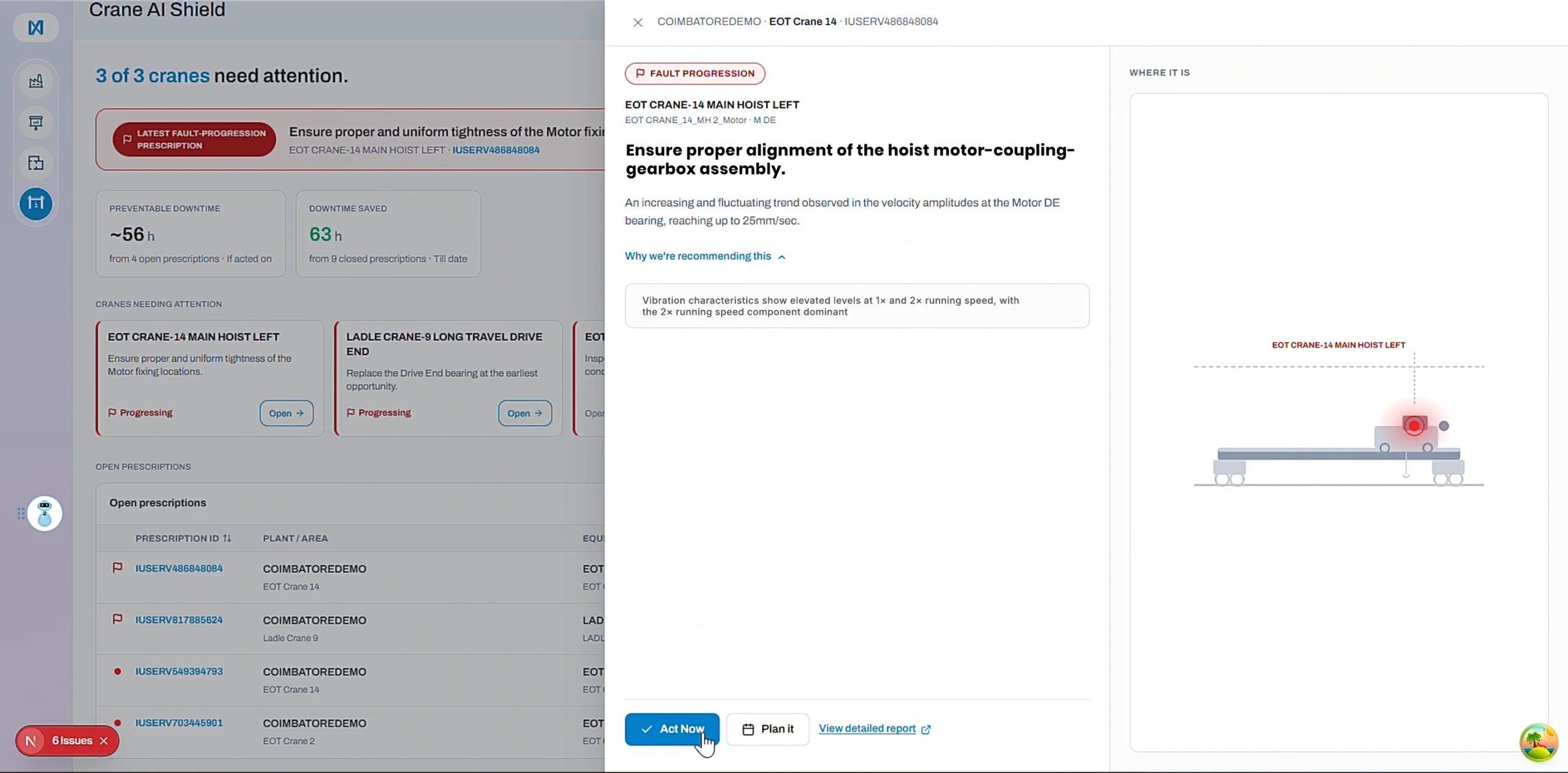
What the operator seesFault progression
flagged — prescription reads “Correct hoist drive coupling alignment
locations.” No spectra to interpret.
03 · Validate
Confirm the fix held — in two taps.
Mark the action done, answer one question (did it predict the fault?), and
the hours
saved are logged straight against the asset.
Crane AI Shield · Confirm
outcome

What the operator seesAction completed
— 2 hrs of downtime saved, attributed to this exact crane. One
question, logged.
04 · Loop closed
Watch the alert turn green — and the model gets sharper.
The motor clears, the prescription closes, and every confirmed outcome
feeds the
99% Trust Loop — making the next call more certain.
Crane AI Shield ·
Resolved
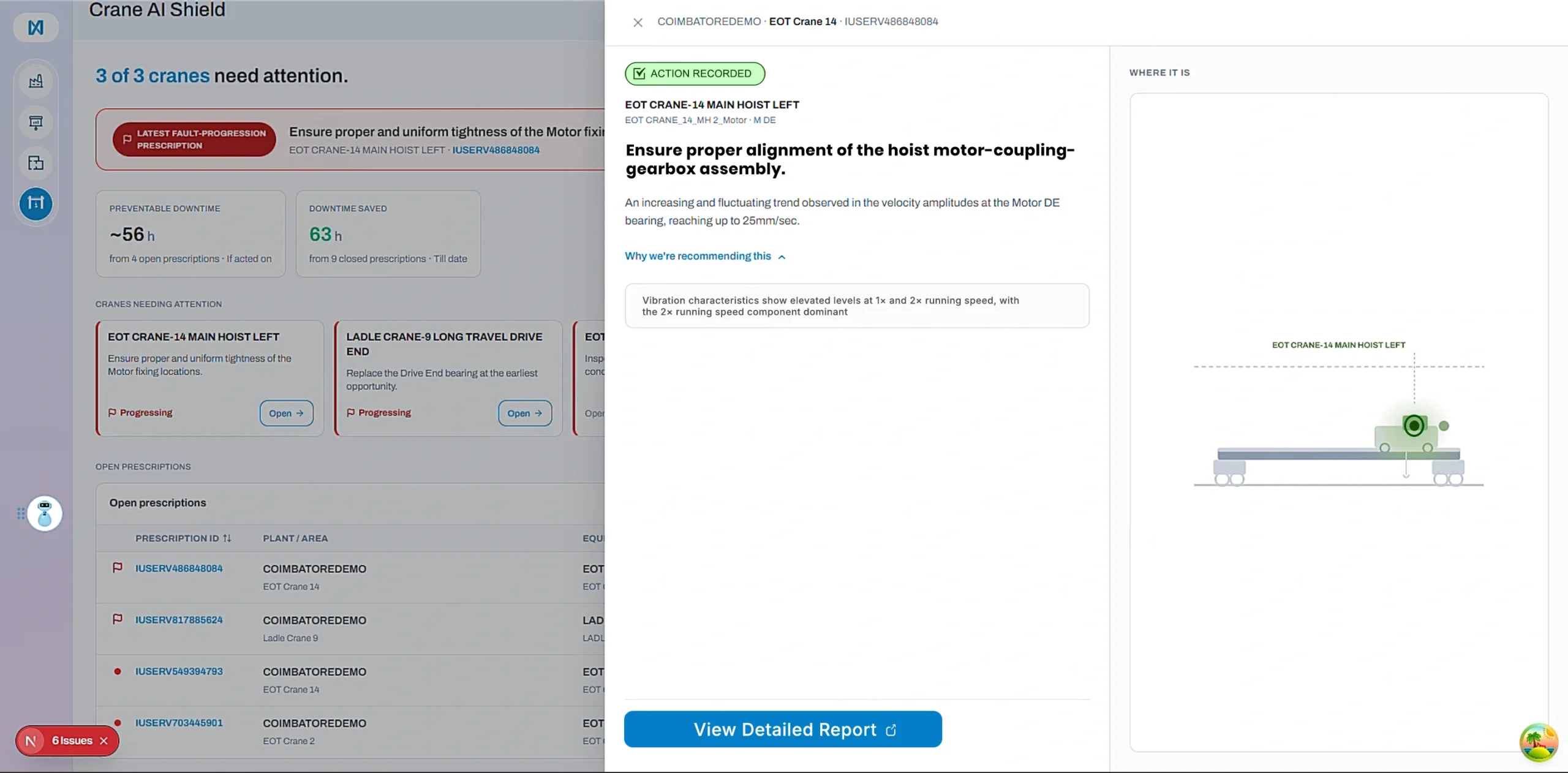
What the operator seesAction recorded
— asset back to healthy. The outcome feeds the model so the next
prescription lands harder.
Operator-validated outcome
A critical EOT crane 90 days of early
warning,
04 hours of unplanned downtime eliminated, one scheduled fix.
The setup
A melt-shop EOT crane runs 300–400 lift cycles a shift. The main hoist motor carries
every one. When its bearing drifts toward looseness, nothing trips and no operator
notices — the crane just keeps lifting toward a seizure that stops the bay.
What we deployed
Crane AI Shield monitored both motor bearings continuously across vibration,
acceleration, and shockwave domains. It read the rising signature
90 days out, prescribed the exact correction, and timed it
into a planned window.
The outcome
One planned stop, re-lube done on schedule. 04 hours of unplanned
downtime eliminated. Vibration down 97% on the bay’s
highest-consequence asset.
0
Days
Continuous monitoring & early detection
00
Hours
Unplanned downtime eliminated
00
Planned stop
Re-lube done on schedule
See the full signal trend, diagnostics, and the verified outcome inside.
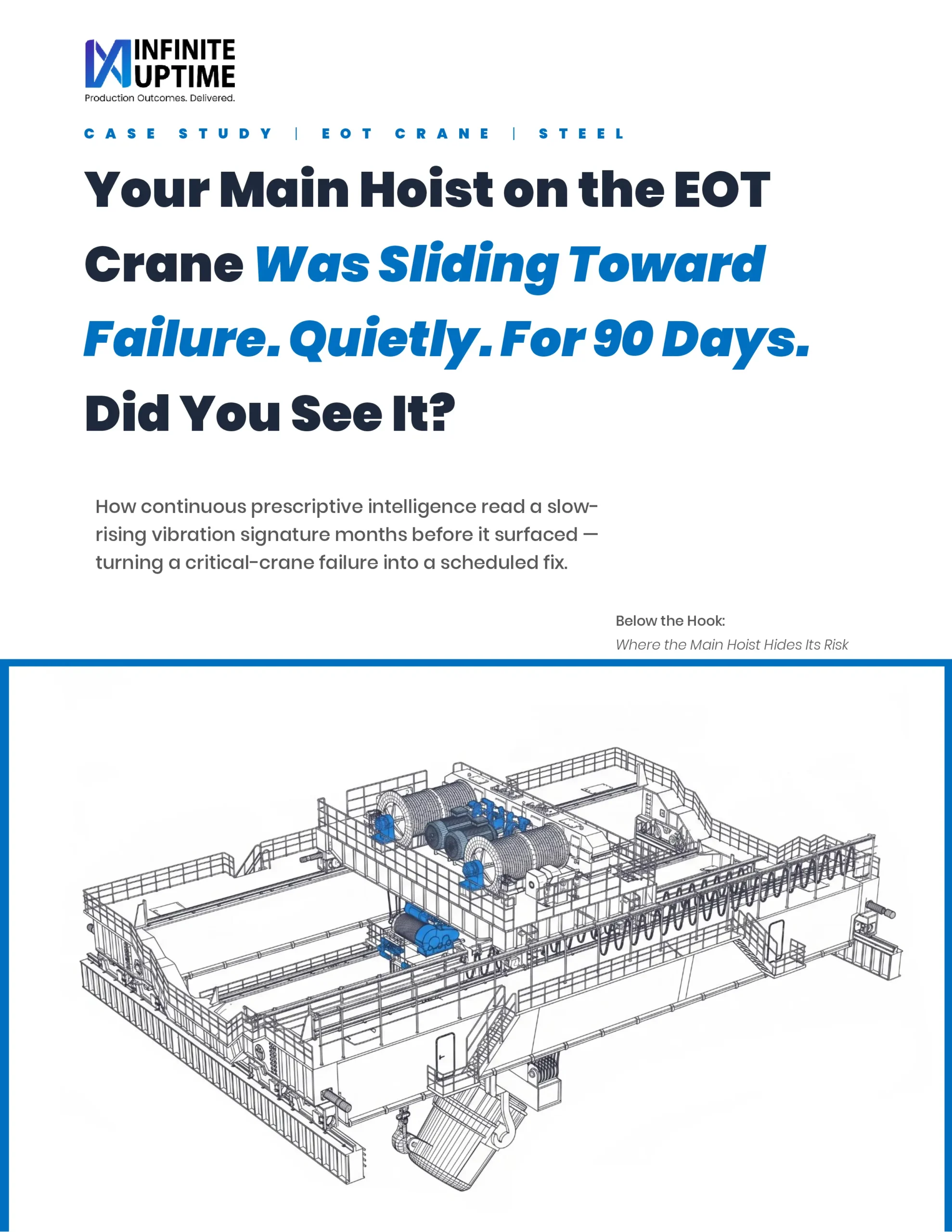
Get the Crane AI Shield Case Study
→
PDF · EOT Crane
Two Systems. One Unified Solution.
The hoist lifts. The long-travel moves. Each fails in its own language —
Crane AI Shield reads both.
Every EOT crane runs on two motor systems — the long-travel that moves it across
the bay,
and the hoist that lifts the load — and Crane AI Shield monitors both.
Live · Crane AI Shield monitoring
Long-Travel System — continuously monitored
Main Hoist Drive — continuously monitored
| Long-Travel System | Main Hoist Drive | |
|---|---|---|
| Role | Moves the entire crane along its rails | Lifts and lowers the load — ladles, slabs, coils, scrap |
| Motion | Horizontal positioning across the bay | Vertical lift under shock load |
| Monitors for | Bearing defects · Lubrication degradation · Wheel-side looseness | Gear-mesh defects · Bearing degradation · Speed-correlated anomalies |
| If it fails |
Crane stranded mid-bay, positioning lost Crane Wheel 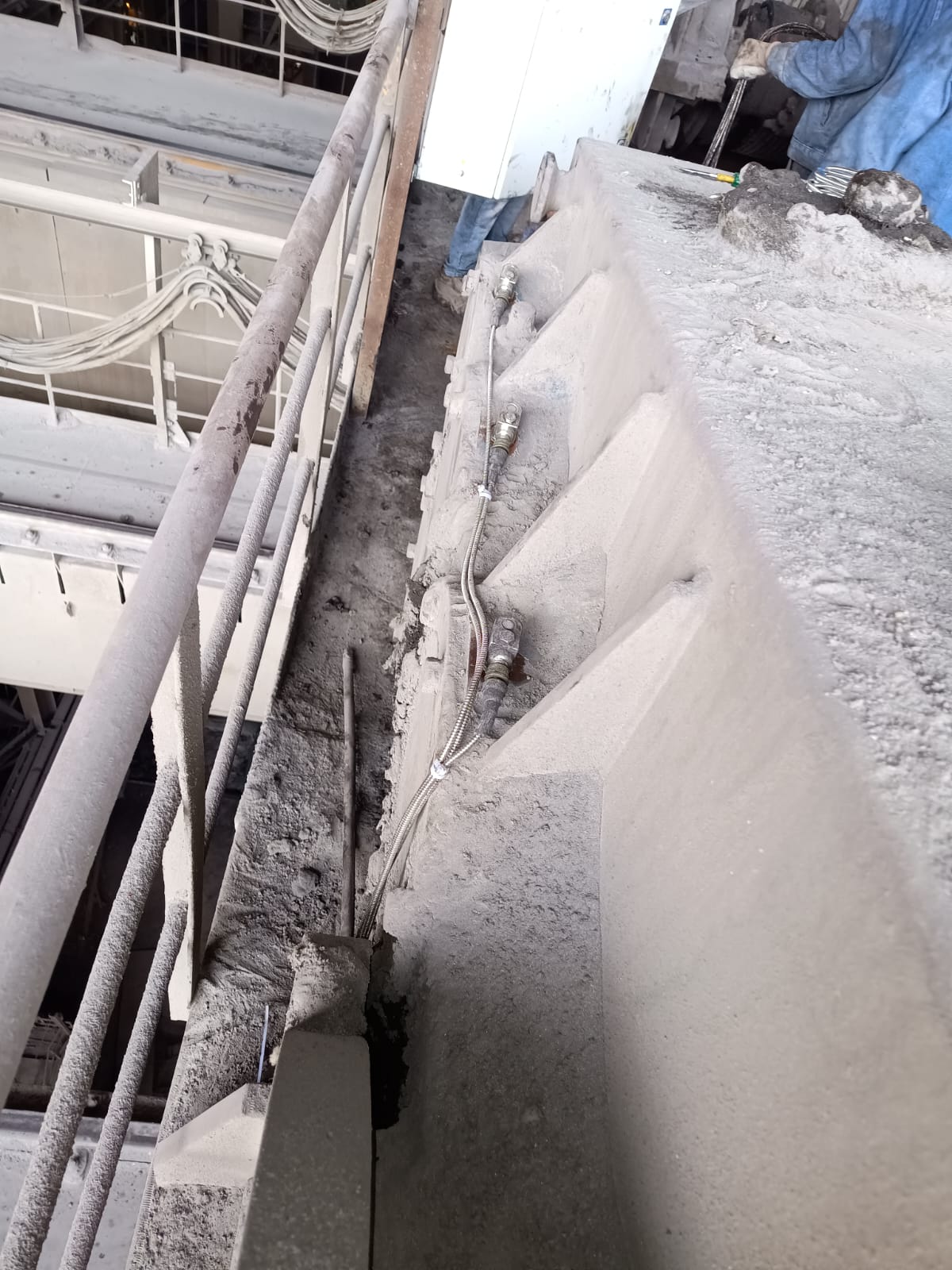 GB Crane Wheel  GB Crane Wheel 1  Crane Wheels |
Suspended-load risk, forced bay stoppage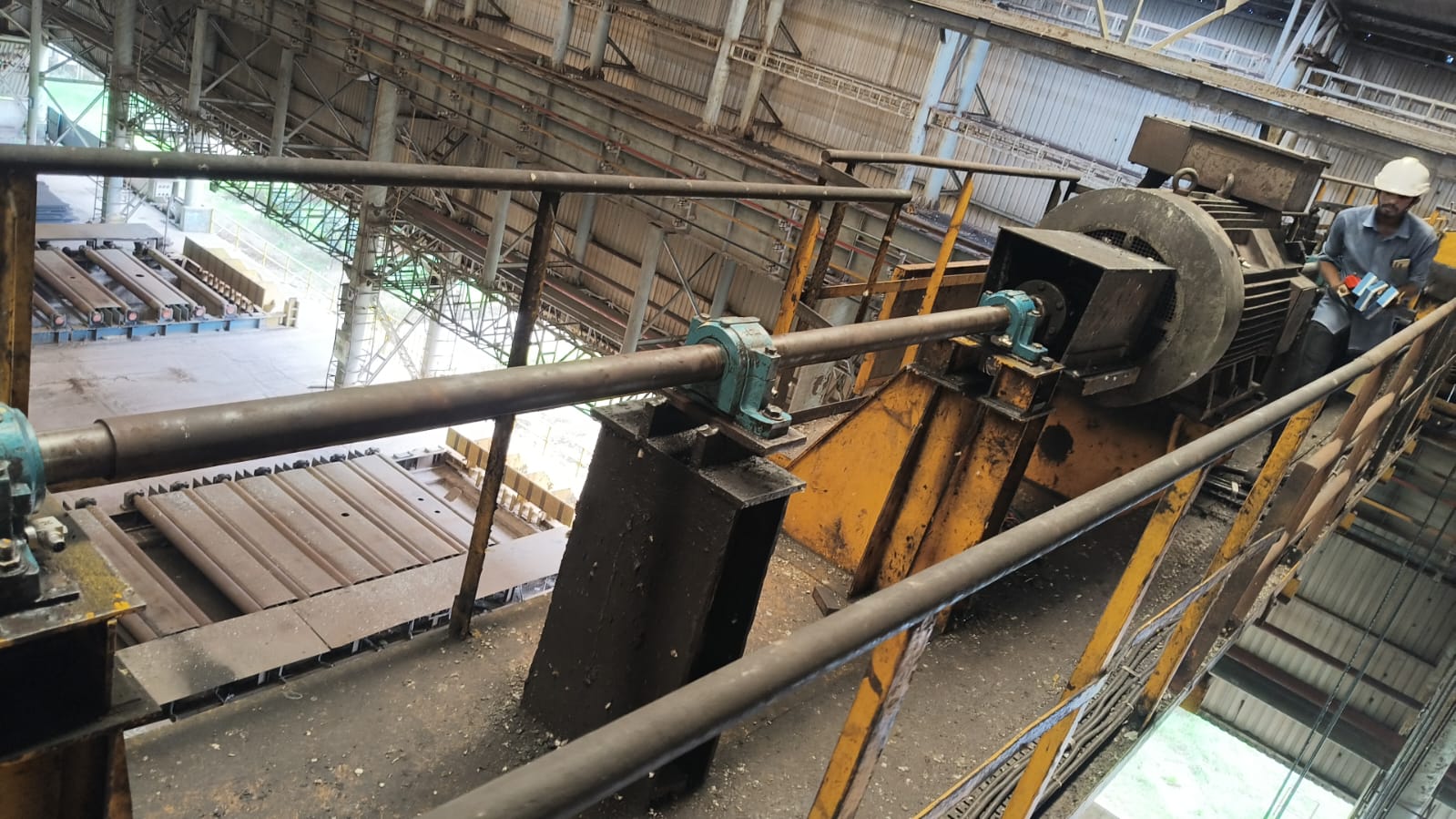 Left Side Support Bearing  Main Hoist Motor NDE  Gearbox & Motor DE |
Hardware and AI — Engineered Together.
Sensors that outlast the foundry floor. AI trained on 3.3 billion real-plant data points.
Engineered as one system — so the prediction holds up where lab-built tools fail.
Crane AI Shield isn’t a sensor and a model bolted together — the hardware proven over
8 years in the field
and the AI trained on real production data are engineered as a single system.
The Hardware8 years in |
The AI in PlantOS™trained |
|
|---|---|---|
| Engineered for | The foundry floor — IP68 SS316 sensors and 180 °C-rated cabling that survive where battery sensors burn out |
Real plants, not the lab — 3.3B+ data points and 99.97% prediction accuracy that sharpens with every closed work order |
| What it delivers | One rugged node captures RPM, temperature, and 3-axis vibration | Prescriptive work orders — which bearing, which gear, which shift to schedule it |
| In the field | Reconfigure remotely — tune sampling and thresholds from the cloud, no truck rolls |
24/7 monitoring with an Infinite Uptime expert on demand |
PlantOS™ — one unified system, one contract, one outcome: predictable uptime.
Six steps from the first site walk to active SLAs — on a fixed, predictable timeline.
W1W2W3W4
W5W6W7W8
Typical timeline — actual dates vary with crane count and site
access.
Hover over each step for details.
Ready to see Crane AI Shield read your crane?
See Crane AI Shield in Action
→
Live walkthrough · your crane, your failure modes
Thank you for your interest in our Crane AI Shield case study.
Enter your work email to download the full story — and see how PlantOS™ Prescriptive AI caught a crane bearing fault 90 days early: 3 outcomes in 1 prescription, zero guesswork.
[contact-form-7 id=”f5320bf” title=”Crane AI Shield pdf downlaod”]
Latest Insights
Your Crane Is Already Going Down. You Just Don’t Know It Yet!!
Your Crane Is Already Going Down. You Just Don’t Know It Yet!! Why standard PdM was never built for cranes — and why the sensors you trust most are silent exactly when faults emerge. Read Time: 8–9 minutes | Author – Chaiitanya Bulusu Key highlights You are managing the most complex and costly asset on the plant floor. Crane downtime is an operations problem — the cascade cost dwarfs the repair bill by 10–15×. The tools you trust most have a structural blind spot. Battery-based PdM(Predictive Maintenance) sensors sample too rarely, stop recording under load, and fail in foundry heat — […]

Your Crane Doesn’t Fail on a Schedule. So Why Is It Monitored on One?
Standard predictive maintenance was built for steady-state machines. A duty-cycle crane behaves nothing like one, and that mismatch is exactly where the failures hide.

When the Crane Goes Down, Everything Stops. Why EOT Crane Reliability Is a Strategic Operations Problem — and How PlantOS™ Solves It Read Time: 8 minutes | Author – Kalyan Meduri Key Highlights EOT crane downtime is an operations problem, not just a maintenance problem. The cascading cost — vessel delays, yard disruption, throughput loss — far exceeds the repair bill. Traditional monitoring (OEM schedules + operator observation) captures failure events, not failure signals. The window for preventive action is missed. Effective crane reliability requires continuous coverage across three domains: mechanical health, electrical health, and safety interlocks. The PlantOS™ architecture delivers a […]